

Published July 2025.
I. Introduction
For more than a century, the AAUP has conducted or sponsored national shared governance surveys at four-year colleges and universities, including the 2021 AAUP Shared Governance Survey, which assessed the perceived level of faculty authority across twenty-nine areas of institutional decision-making.1Each of these surveys provided a snapshot of the state of shared governance at the time it was conducted, and together they provide vital information about the historical development of academic governance in the United States over the past one hundred years.
In 2024, the AAUP, in partnership with the Center for the Study of Community Colleges, conducted an inaugural shared governance survey focused on community colleges, the institutions educating nearly 40 percent of all undergraduates in the United States.2The survey instrument mirrored the one used for four-year institutions, examining faculty authority across twenty-six areas of institutional decision-making. (Three areas included in the 2021 survey instrument did not apply to community colleges.) Findings from this survey provide insights into areas of faculty authority and administrative collaboration in the nation’s public community colleges and allow for a more robust under standing of shared governance across American higher education.
Public community colleges have a variety of governance structures. Indeed, the Association of Community College Trustees identifies fifty different models of community college governance, falling into four broad categories: a local community college board, a state-level community college board, a state-level higher education board (which includes other postsecondary institutions), and a university governing board that encompasses some or all of a state’s community colleges. Table 1 lists community college state-level governance models by state.
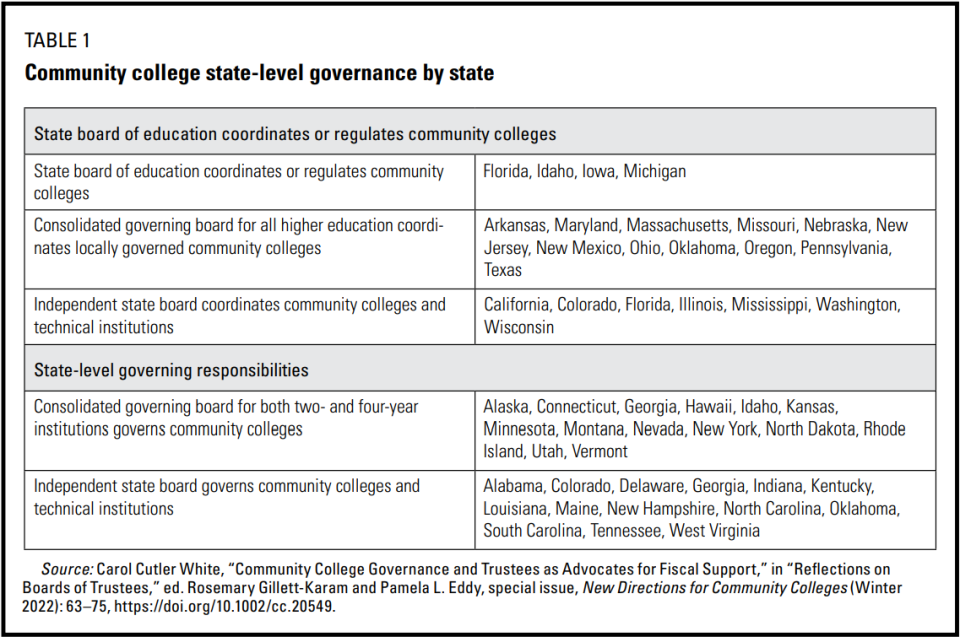
This variety of governance structures, as well as the fact that nearly 70 percent of community college faculty are employed part time, has major implications for community college shared governance structures and policies. Furthermore, community colleges are a highly unionized sector of higher education: Just under half of all community colleges have collective bargaining agreements in place, covering 44 percent of full- and part-time faculty members.3 These collective bargaining agreements add another layer to shared governance processes. Regional accrediting agencies also influence shared governance, as each agency has its own standards for effective institutional governance, including a commitment to shared governance.
This report focuses on internal shared governance processes and, more specifically, on faculty perceptions of their levels of authority in various decision-making areas. In community colleges, shared governance occurs formally through faculty senates (college, statewide, or systemwide), faculty assemblies, and academic councils or faculty associations and informally through collegial decision-making processes. Colleges without formal governance groups may include faculty leaders on college-wide committees focused on strategic planning, budgetary planning, or other topics.
Unlike AAUP-supported standards relating to academic freedom, tenure, and due process, which can be highly specific, AAUP-recommended governance standards tend to be general, reflecting the understanding that governance practices vary among institutions according to size, mission, history, presence or absence of collective bargaining, and other factors. The 1966 Statement on Government of Colleges and Universities, the AAUP’s foundational document on academic governance, identifies decision-making areas in which the faculty should exercise “primary responsibility” (corresponding approximately to “faculty primacy” in the survey), but it also identifies decision-making areas in which the faculty should participate meaningfully without exercising primary responsibility.4 Since the conception of shared governance incorporates the notion that the level of faculty authority in decision-making differs between decision-making areas, the AAUP’s recommended governance standards specify expectations for minimum levels of faculty participation in many such areas.
This first-of-its-kind survey of community college shared governance can provide information about what practices prevail nationally and how they compare with normative standards of academic governance in community colleges. Although differences between the four-year and community college sectors render comparisons relatively useless, both in theory and in practice, toward the end of this report we provide some information about how results from this survey relate to those of the AAUP’s 2021 Shared Governance Survey of four-year institutions to illustrate how areas of faculty authority may vary among institutional types and to paint a more comprehensive picture of the landscape of shared governance in US higher education. In addition, results from this survey can provide users with benchmarks to compare their governance practices with national trends. To that end, the AAUP’s Department of Research and Public Policy will provide a version of the survey instrument for local use following the publication of this report.
II. Composition of the Population
The United States is home to 1,022 public community colleges, according to the definition of a community college as “any accredited public or nonprofit institution that awards the associate as its highest degree or that offers at least one baccalaureate program but confers more than 50 percent of degrees at the associate level.”5This definition includes institutions that the Carnegie Basic Classification system categorizes as associate’s or baccalaureate/associate’s colleges,6including two-year tribal and historically Black colleges and many technical institutes, both public and private. According to the Integrated Postsecondary Education Data System (IPEDS), private nonprofit institutions make up a mere 9 percent of community colleges, while public institutions comprise 91 percent. Given the composition of the sector, the 2024 AAUP Community College Shared Governance Survey was administered to a simple random sample of senate chairs or faculty governance leaders at 507 public community colleges drawn from the IPEDS directory. Fifty-nine community colleges responded to the survey, leading to a 12 percent response rate.
Unlike in the four-year sector where nearly three-quarters of institutions have tenure systems, only 58 percent of community colleges have a tenure system in place (and about two-thirds of full-time faculty members at these community colleges have tenure), although many institutions without tenure systems allow full-time faculty members to apply for continuous contracts, which ensures some level of job stability.7Nonetheless, we included responses about full-time faculty members at colleges without a tenure system in the full-time non-tenure-track category throughout this report. For additional information about the sample for this survey, as well as other information about methodology, please see the appendix.
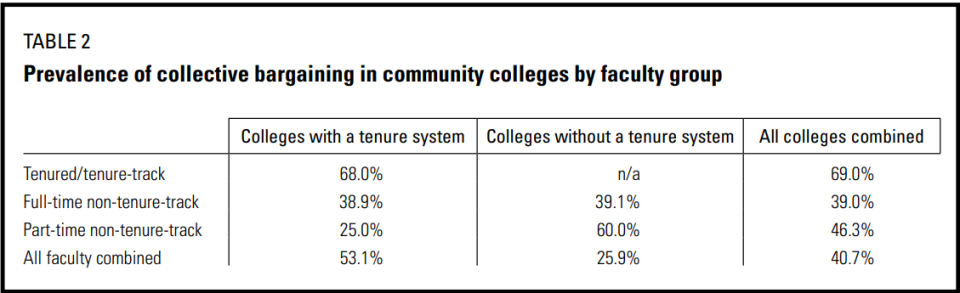
IPEDS does not collect information on faculty collective bargaining, so the AAUP’s survey asked whether different groups of faculty members were unionized in order to analyze possible differences in governance practices by collective bargaining status. Table 2 provides estimates of the prevalence of faculty unions based on responses to the survey questions for each of three groups: tenured and tenure-track, full-time non-tenure-track, and part-time non-tenure-track faculty members. Percentages shown in table 2 indicate that survey respondents slightly underestimate the percentage of community college faculty members operating under collective bargaining agreements (41 percent of survey respondents, compared with the national average of 52 percent8). The small sample size precludes analyses by additional subgroups, such as comparisons between governance models or different types of community colleges.
III. Areas of Decision-Making and Survey Scales
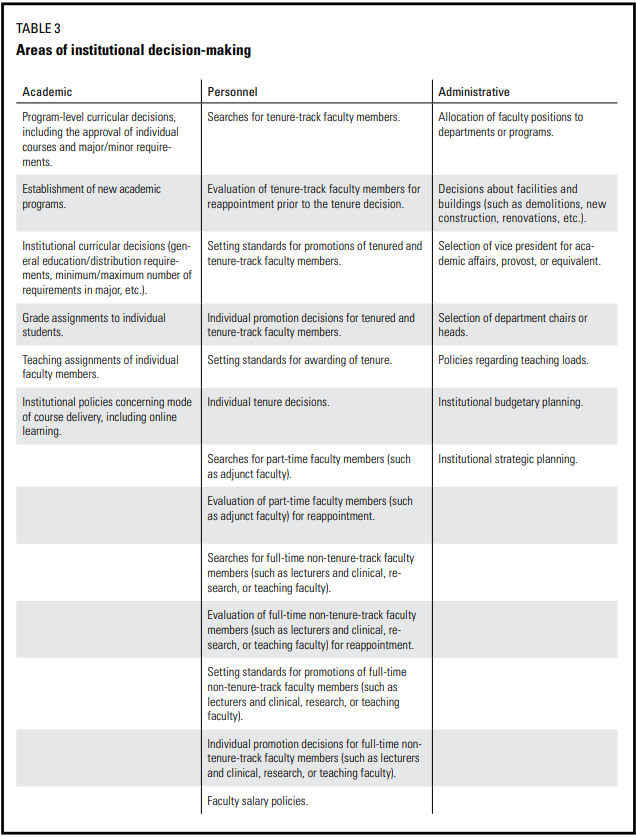
Table 3 lists the twenty-six areas of institutional decision-making with the wording used in both the 2021 survey distributed to faculty members at four-year colleges and universities and the 2024 survey distributed to faculty members in community colleges. These areas are grouped into three categories—academic, personnel, and administrative—based on Joseph W. Garbarino and Bill Aussieker’s analysis of the 1971 AAUP governance survey.9
The scale on which respondents assessed the faculty role in decision-making for each area consisted of the following five categories: administrative dominance, administrative primacy, shared authority, faculty primacy, and faculty dominance. The names and definitions of these scale points, also used in the 2021 Shared Governance Survey, were adapted from a 1967 task force on faculty representation and academic negotiations.10 The survey instrument contained the following definitions:
Dominance: A group is making decisions in an area essentially unilaterally. The other group is informed of the decision or consulted in a pro forma fashion but generally has no influence on the outcome.
Primacy: A group has primary authority for an area but the other group has an opportunity to participate meaningfully in the final decision. If there is disagreement between the two groups, the group that has primacy normally prevails.
Joint Authority: This level of participation means that both groups exercise equal influence in making decisions in an area. If an area is subject to collective bargaining between a union and the administration or board, the level of faculty participation should presumably be “joint authority.”
Faculty: If decisions in a particular area are made by the department chair or head, they should be considered as being made by the faculty if heads or chairs are chosen by departmental election on a regular schedule. Otherwise, faculty participation needs to occur through an elected senate or council or through the general faculty.
Administration: Deans, associate deans, provosts, associate provosts, etc., should be regarded as administration, regardless of whether they may hold faculty rank. Department chairs or heads who are not chosen by departmental election on a regular schedule should be regarded as administration.11
The survey instrument provided the following instructions in the section on assessing faculty authority by area: “For each of the following areas of decision-making, please provide your assessment of the level of faculty participation. In judging the level of faculty participation, please assess the actual practice as employed on campus rather than how the level of faculty participation is specified in institutional regulations or bylaws.”
The focus on governance practices rather than on governance policies is essential because, first, institutional regulations frequently stress the final authority of the governing board even though in practice the board regularly delegates that authority in certain areas to the faculty or to the administration and, second, some institutional regulations contain lofty pronouncements about the administration’s and board’s commitment to shared governance that actual practice may not reflect. The survey instrument did not ask about rare occurrences, such as dismissals for cause or program eliminations, because respondents most likely could not have adequately assessed the level of faculty participation in those areas as a matter of general practice.12 Because governance practices in the areas under consideration can differ among departments, colleges, or districts, the survey instrument asked respondents to report their estimation of the most common form of faculty authority across units. Survey results thus provide an essential glimpse into areas of faculty authority across multiple aspects of community college governance and operation.
IV. Findings
This report presents the findings of the survey as diverging stacked bar charts, a common format for the presentation of data collected on so-called Likert scales, which are ordered to measure attitudes, such as agreement, with scale points that express the intensity of the attitude. Such bar charts depict the percentage of responses for each category in order on the scale, with the bars centered on the midpoint of the scale at a point that represents the middle or neutral category (for example, “neither agree nor disagree” in a Likert scale of agreement). In this case, the categories are ordered from least to most faculty authority, and the middle category is “joint authority”—equal faculty and administrative authority.
As noted above, AAUP-supported standards of academic governance reflect an expectation that the level of faculty authority will differ between areas of decision-making. The survey instrument accordingly stated, “Although the order of the forms of participation listed here are in descending degree of faculty participation, it is not meant to imply that ‘faculty dominance’ is considered more desirable than the other categories for all of the questions listed.” Thus, when we assess many of the above-listed areas that are identified as academic, “administrative primacy” would probably fall below the level established under AAUP-supported standards, but in the case of some of the areas identified as administrative, in particular budgets, “administrative primacy” in general would still signify that faculty members had the opportunity to participate meaningfully in decision-making—in other words, in some of these areas, administrative dominance, but perhaps not administrative primacy, would be at odds with AAUP-supported governance standards. However, the AAUP did not formulate governance standards with the categories of faculty authority used in this survey in mind, so in some cases findings are compared to an interpretation of governance standards rather than to an explicit statement of policy with respect to minimum levels of faculty participation.
A. The Limits of Faculty and Administrative Authority
The AAUP has found that assessing levels of faculty and administrative authority is a useful approach for understanding the state of shared governance in institutions of higher education, it is worth noting the danger of assuming that all institutional decision-making takes place in some combination of these two realms. Indeed, especially in the public sector, some governance decisions are made at a board or statewide system level—taking them out of the hands of faculty members and administrators completely— and still others are legislatively mandated or otherwise externally influenced or controlled. Furthermore, governance has become increasingly complex as more internal and external constituents have staked claims to returns on public investment. As one respondent lamented, the faculty’s role in governance is often “limited to carrying out policies and regulations that are imposed by external entities like the state chancellor’s office, the state legislature, and the accreditation agency. Faculty’s role is [to] figure out how to comply, in the least harmful way possible, with policies and procedures for which it never had a voice in creating.”
Furthermore, some states have recently taken action to assume control over areas that have historically fallen into faculty dominance or primacy categories, including the design and development of programs and institutional curricula. Perhaps most notably, in 2023 the Florida legislature specified the content, principles, and standards for all general education courses across the state university system and the Florida college system, essentially stripping authority from both faculty members and administrators to make decisions about general education at their institutions. While the extent to which Florida’s actions to eviscerate institutional autonomy and self-governance will be emulated in other states is still unclear, this example serves as a reminder that—in some cases—items included in this survey instrument may be viewed as false dichotomies in that neither faculty members nor administrators have the authority to make certain decisions.
B. Faculty Authority in Academic Decisions
In general, community college faculty are meaning fully involved in academic decision-making at most institutions (see figure 1). Indeed, faculty authority for individual grade assignments, a core area of academic freedom, is a faculty prerogative across the board, with 100 percent of respondents reporting faculty primacy or faculty dominance in determining grades. At the other end of the spectrum are decisions related to course delivery, where only 16.3 and 11.6 percent of respondents, respectively, reported faculty primacy or dominance. As this is the AAUP’s inaugural survey of community college shared governance, we do not know whether administrative authority over the mode of course delivery increased in the years since the COVID-19 pandemic, but it seems likely that this is the case. Authority over teaching assignments varied substantially across colleges: Just under one-third of respondents indicated faculty primacy or dominance in decisions about teaching assignments, another third reported administrative primacy or dominance in this area, and 37.2 percent indicated that faculty members and administrators had joint authority over teaching assignments.
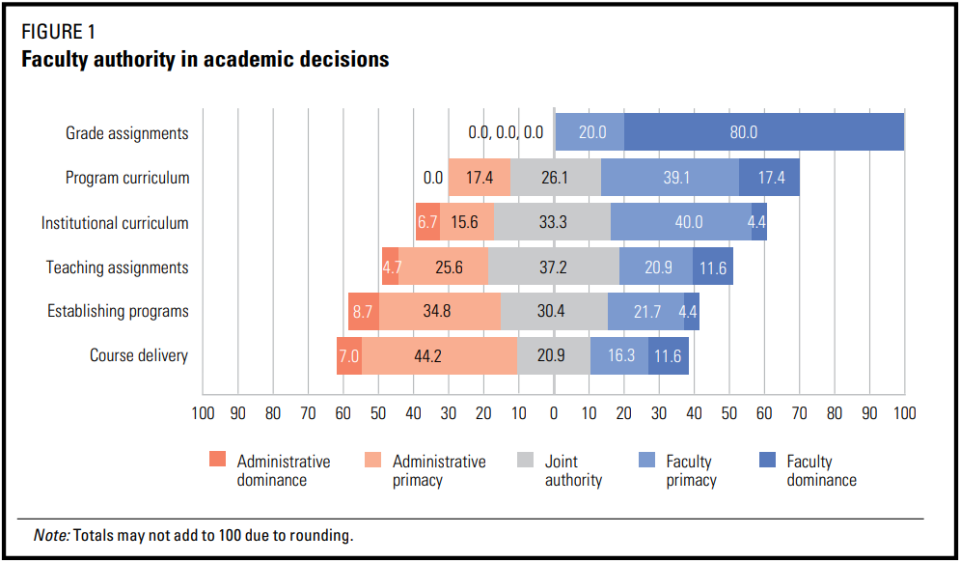
The share of faculty control in curricular decisions declines somewhat from the programmatic level to the institutional level and is sharply lower with respect to decisions about new programs, with the combined share of faculty primacy and faculty dominance going from 56.5 percent for program curriculum to 44.4 percent to institutional curriculum to 26.1 percent for establishing programs. To the extent that the level of faculty authority in these three areas falls below faculty primacy, institutional responses would seem to represent a departure from normative standards of academic governance as set forth in the Statement on Government, but faculty authority over some curricular decisions at community colleges and, in particular, over the establishment of new programs, is complicated by the institutions’ mission to be responsive to local economic and workforce needs.
C. Faculty Authority in Personnel Decisions
Several patterns emerge from the findings summarized in figures 2A and 2B. First, the level of faculty authority for various types of personnel decisions for each faculty group (tenured and tenure-track, full-time non-tenure-track, part-time non-tenure-track) ranks as follows, from greatest to least: (1) standards, (2) evaluations, (3) searches, and (4) decisions. (Standards and decisions apply only to full-time faculty members, as systems of promotion and tenure for part-time non-tenure-track faculty members are rare.) Levels of faculty authority over salary policies are also low (only 13.9 percent of respondents reported faculty primacy or dominance in salary policies), but at 41.9 percent of institutions, faculty members and administrators were jointly responsible for these policies.
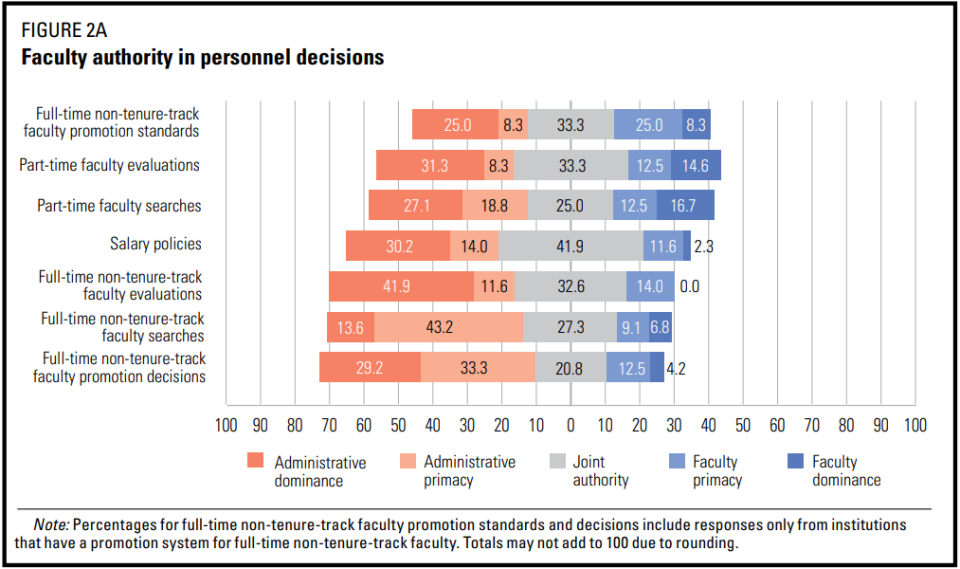
Second, the relative positions of the various non-tenure-track faculty groups in figure 2A are notable: With the exception of setting promotion standards, the percentage of respondents reporting faculty primacy or dominance is lower for personnel decisions concerning evaluations, searches, and decisions for full-time non-tenure-track faculty members than for those related to part-time faculty members. The relatively high level of faculty authority for decisions concerning part-time faculty members likely reflects the fact that hiring decisions for those faculty members are usually made at the departmental level with little administrative oversight. The reported prevalence of administrative primacy and administrative dominance may result from the fact that department chairs are typically making those decisions at institutions where they are not selected by the faculty, in which case the survey instrument instructed respondents to treat the chair as an administrator.
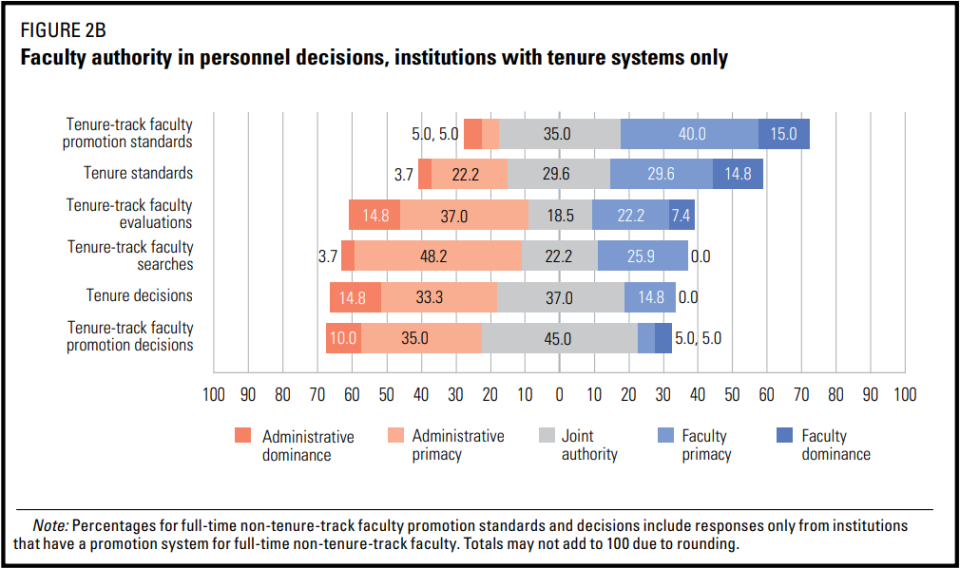
Third, levels of faculty authority over promotion standards and decisions, evaluations, and searches for full-time faculty members are higher at institutions with tenure systems (and for full-time tenured or tenure-track faculty members) than among all institutions or for full-time non-tenure-track faculty members (see figures 2B and 2A). These findings mirror those in the 2021 AAUP Shared Governance Survey, which concluded that, especially as it relates to personnel decisions, “the faculty role at institutions without a tenure system is weaker overall than it is at institutions with a tenure system.”13
D. Faculty Authority in Administrative Decisions
In areas categorized as administrative, responses of administrative dominance, because they indicate that faculty members have little meaningful involvement, would fall short of Association-supported governance standards. Nonetheless, as figure 3 illustrates, administrative dominance is the most common response across all institutions in decisions about facilities and buildings (68.9 percent), budgets (67.4 percent), and allocation of faculty positions to departments or programs (52.2 percent). In these areas, as well as in strategic planning, 80 percent of respondents indicated having little to no involvement.
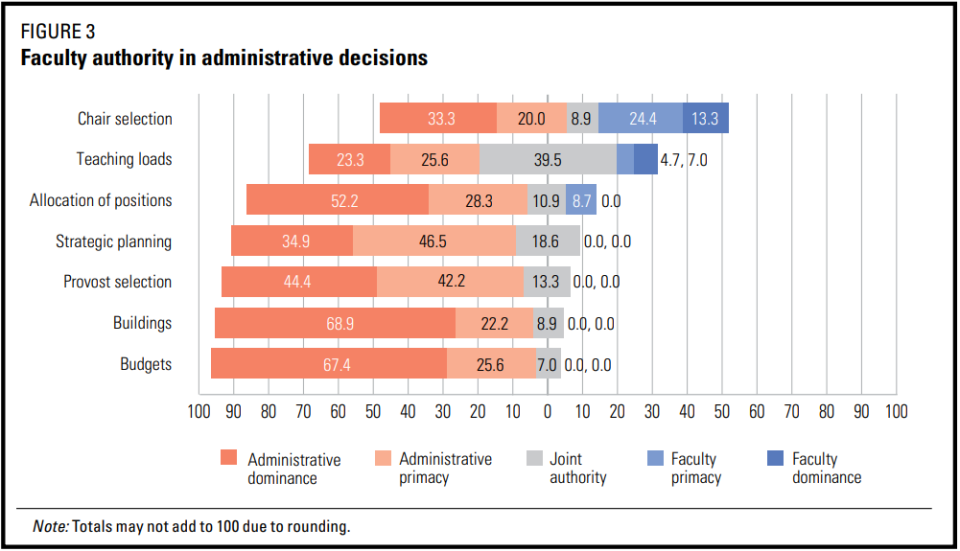
Furthermore, Association-supported governance standards concerning the selection of academic administrators, such as provosts or academic vice presidents, call for meaningful involvement of faculty members in the search process to “reflect the primacy of faculty interest.”14 Yet within community colleges, these appointments are nearly always made by administrators, although the faculty has joint authority over provost selection at 13.3 percent of responding institutions. The faculty has more authority over the selection of department chairs or heads: Faculty members have primacy in this area at nearly one in four colleges and dominance at an additional 13.3 percent. Nonetheless, more than half of respondents indicated that their institutions select department chairs with little to no faculty involvement.
Finally, although administrators generally dominate decisions about teaching loads at community colleges, faculty members have primacy or dominance in this area at a handful (11.7 percent) of responding institutions, and in 39.5 percent of colleges faculty members have joint authority for such decisions.
E. Shared Governance and Collective Bargaining
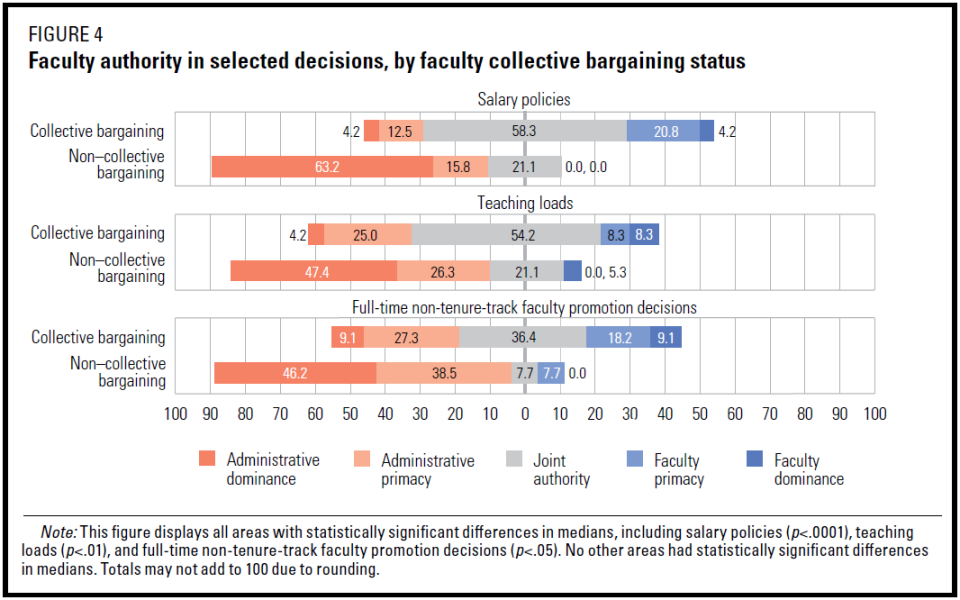
When comparing faculty authority in decision-making at institutions where the faculty bargain collectively with those where they do not, the most important caveat is that, for areas that are subject to bargaining, joint authority is the normative level of faculty authority, since, by definition, decisions in those areas require the agreement of both parties. Thus, a comparison that does not take the special status of joint authority into account misses an essential difference between unionized and nonunionized settings. Furthermore, analyses of differences in faculty authority by collective bargaining status are complicated by the fact that some states—such as Texas, Georgia, and the Carolinas—do not permit faculty unionization.
Perhaps it is not surprising, then, that statistically significant differences in the level of faculty authority between unionized and nonunionized colleges appear in only three of the twenty-six areas.15 This finding mirrors that in the AAUP’s 2021 Shared Governance Survey of four-year institutions, which found statistically significant differences in seven of twenty-nine areas. Together, these findings contribute to long standing debates about whether significant differences in governance practices exist between unionized and nonunionized institutions. In particular, consistent with findings dating back to 1971, both the 2021 and 2024 surveys found that institutions where the faculty engages in collective bargaining have higher levels of faculty authority in areas related to salary policies, teaching loads, and, in the case of community colleges, full-time non-tenure-track faculty promotion decisions (see figure 4).16
V. Shared Governance in Community Colleges and Four-Year Institutions
Our intention in conducting this inaugural survey of shared governance at community colleges was not to compare levels of faculty authority at these institutions with those in the four-year sector, as numerous contextual differences render such comparisons relatively useless in practice. In particular, higher levels of faculty unionization, fewer institutions with tenure systems, the need for responsiveness to local communities, and the fact that nearly two-thirds of community college faculty are employed part time influence levels of faculty authority across all areas of institutional functioning. Furthermore, shared governance in community colleges deserves to be studied in its own right—not simply because levels of faculty authority may differ from those at other types of colleges and universities. Nonetheless, because the 2024 Community College Shared Governance Survey utilized (nearly) the same survey instrument as the AAUP’s 2021 survey of four-year institutions, comparisons across institutional types are possible and, in some cases, may be illuminating and useful for further scholarship and practice.
There are two major caveats to the following discussion of faculty authority across both community colleges and four-year institutions. First, although the 12 percent response rate to this inaugural survey of community college shared governance was neither unexpected nor out of the norm for online surveys, the total number of respondents is low enough that we caution against generalizing findings to the entire universe of community colleges.17 Second, the 2021 Shared Governance Survey asked respondents to provide their assessment of the level of faculty participation before the COVID-19 pandemic, whereas in the 2024 survey community college respondents were instructed to indicate current levels of faculty authority. Thus, any differences in shared governance patterns between community colleges and four-year institutions may be at least somewhat attributable to broader shifts in faculty authority over the past five years. Indeed, the AAUP’s 2021 report on COVID-19 and academic governance stated that the pandemic “presented the most serious challenges to academic governance in the last fifty years,” detailing numerous accounts of breakdowns of shared governance at selected institutions.18
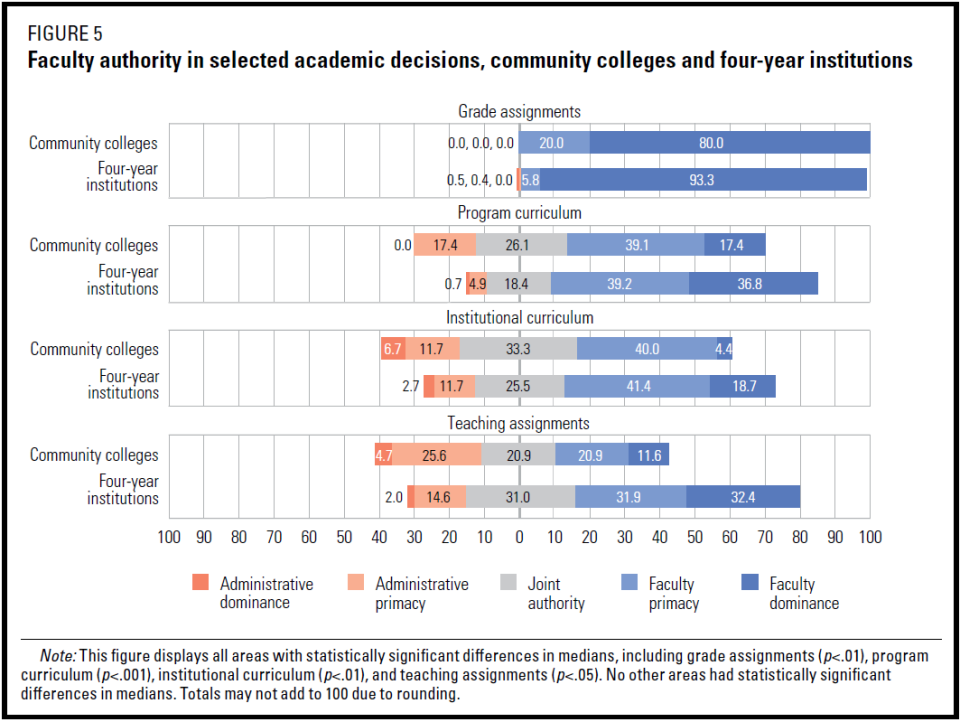
As shown in figure 5, across most areas of academic decision-making, levels of faculty authority are lower at community colleges than at four-year institutions, although differences in program establishment and mode of course delivery (not shown) are not statistically significant. The differences in levels of faculty authority may be due, in large part, to higher numbers of part-time and other contingent faculty members at community colleges (reducing the number of full-time and tenure-track faculty members available to participate in shared governance) and to a perceived need for greater administrative coordination of curricula to meet local workforce needs.
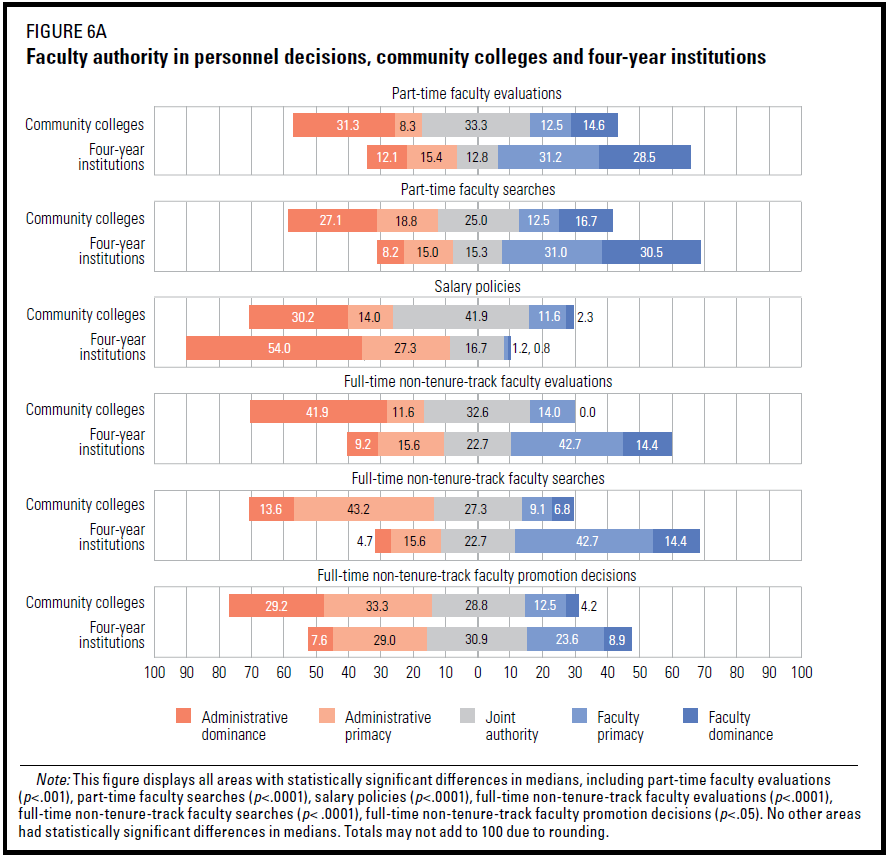
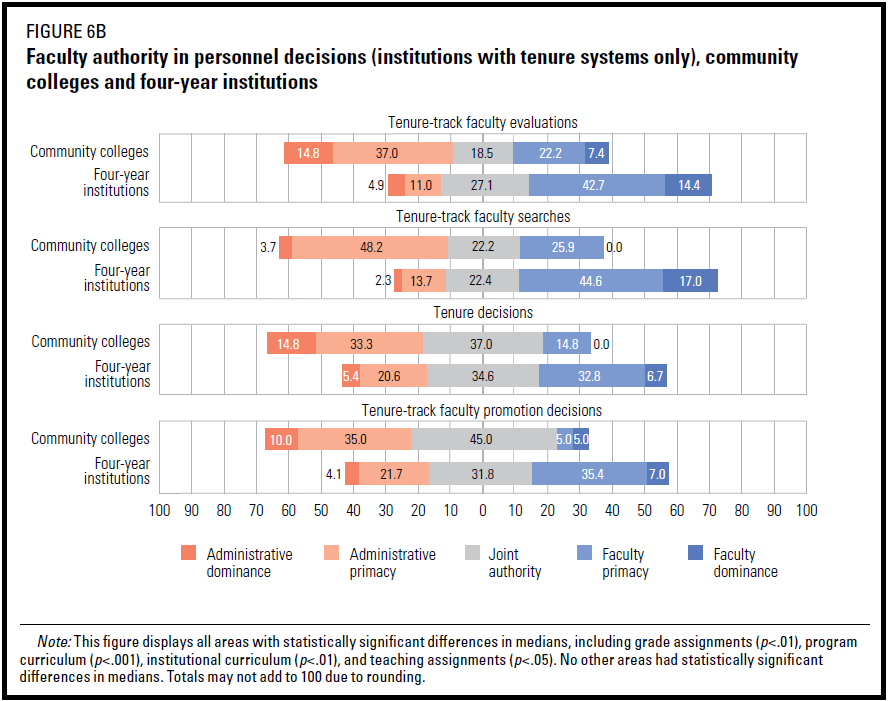
The community college sector similarly exhibits lower levels of faculty authority in most faculty personnel decisions (see figures 6A and 6B), although differences in tenure and promotion standards were not statistically significant. This is perhaps to be expected in institutions with higher percentages of part-time and other contingent faculty members. However, faculty members at community colleges have more involvement in salary policies than those at four-year institutions: these decisions are jointly undertaken at 41.9 percent of the community colleges responding to this survey, and faculty members have primacy or dominance at another 13.9 percent (see figure 6A). Greater community college faculty authority in salary policies is almost certainly related to the higher prevalence of institutions with collective bargaining in that sector. Across the administrative realm, there were no statistically significant differences in faculty authority by institutional type, most likely because faculty members in both sectors exhibit little meaningful participation in most aspects of administrative decision-making.
VI. Conclusion
The purpose of the inaugural AAUP Community College Shared Governance Survey was to provide previously unavailable information about academic governance in the institutions that educate nearly 40 percent of all US undergraduates, including some of the most marginalized and vulnerable students, and to assess the relationship between collective bargaining and levels of faculty authority within community colleges. In addition, although doing so was not our primary intention, this study enables comparisons of the current state of shared governance at community colleges with that at four-year institutions prior to the COVID-19 pandemic. Findings from this survey thus fill an important and often-overlooked void in the higher education governance literature, elevating issues surrounding shared governance at the nation’s community colleges to a level of attention that the faculty and administrators working in these institutions deserve.
Overall, the results of this survey present a mixed picture of community college shared governance. At most responding institutions, and especially at responding institutions with tenure systems, faculty authority is consistent with AAUP-recommended governance standards in decision-making about programmatic, departmental, and institutional curricula; teaching assignments; salary policies; and faculty searches, evaluations, and tenure and promotion standards. However, in several decision-making areas, including budgets, buildings, provost selection, and strategic planning, community college faculty have few meaningful opportunities to participate. In these areas, community colleges deviate from the principles outlined in the Statement on Government of Colleges and Universities, which emphasizes faculty involvement in personnel decisions and budget preparation.
Although questions continue to be raised about the relationship between collective bargaining and shared governance, few statistically significant differences between unionized and nonunionized colleges were apparent in this survey or in the AAUP’s 2021 survey of four-year institutions. Indeed, the areas where collective bargaining did appear to make a (statistically significant) difference were those typically specified in bargaining agreements, including salary policies and teaching loads.
As it is the first national survey of shared governance practices at community colleges, this study holds numerous implications for research and practice. In particular, scholars might investigate how various shared governance practices influence campus climates or contribute to student progress and success. They might examine how community colleges can support part-time faculty and socialize them into shared governance practices. Or they might take steps to understand what the concept of shared governance means to administrators as well as faculty members. There is also an opportunity to investigate the ways that shared governance is practiced outside formal channels, in what higher education researcher Susan Talburt called the “everyday and the informal.”19 In addition, scholars might investigate whether the COVID-19 pandemic only temporarily depressed faculty authority at community colleges and four-year institutions or whether it normalized lower levels of shared governance in either or both sectors.
Finally, the AAUP has developed and promulgated recommended principles and standards regarding the governance of colleges and universities,20 including community colleges, but few institutions have had the means to determine whether the principles are being realized. Community college–based faculty members and administrators can use the tools described in this report to assess governance practices at their institutions and compare those practices with national trends to identify areas where levels of faculty authority might be strengthened. Given the current political climate, economic uncertainty, demographic changes, and chronic underfunding of US higher education, now is the time for community colleges to identify and correct weaknesses in their own shared governance practices. The Statement on Government of Colleges and Universities was jointly formulated by the AAUP, the American Council on Education, and the Association of Governing Boards of Universities and Colleges, and it was “intended to foster constructive joint thought and action, both within the institutional structure and in protection of its integrity against improper intrusions.” This report and its associated tools complement the Statement on Government, and together they can help community college governing board members, administrators, faculty members, students, and other campus community members work together to establish sound structures and procedures.
Appendix: Methodology
Given the small sample size of this inaugural survey of community college shared governance, caution should be exercised when generalizing the results to the entire population of community colleges. However, the results do provide baseline perspectives and a first glimpse at shared governance in the community college sector. The survey was administered in fall 2024 to one respondent (senate chairs or faculty governance leaders in a similar role) at each of a simple random sample of 507 institutions. In instances where a faculty governance representative could not to be located online, or for institutions where the faculty union rather than a senate or a similar body fulfilled faculty governance functions on campus, the faculty representative to the bargaining unit was prioritized. The choice of respondents based on their role in an institution (in this case, the governance system) is a common practice in organizational surveys, where such respondents are called “key informants.”
Administration of the survey was affected by unforeseen delays and AAUP staff turnover, and thus email addresses of faculty governance representatives that were collected in 2023 were, in many cases, no longer accurate by the time the survey was administered in fall 2024. The original sample consisted of 602 community colleges, consistent with the sample strategy used in the 2021 AAUP Shared Governance Survey. However, some of the key informants at those institutions had departed by the time the survey was administered. When an obvious suitable respondent was no longer present at an institution, that college was dropped from the study, reducing the sample size to 507. The overall response rate was 12 percent, which was in line with our expectations.
Because the responses for most items were generally not normally distributed, we used the Mann-Whitney U test, sometimes called the Wilcoxon rank-sum test, to compare the differences in median responses between samples, either collective bargaining and non-collective bargaining or community colleges and four-year institutions. A p-value less than 0.05 was considered to indicate a statistically significant difference between the groups.
GLENN COLBY
Senior Researcher, AAUP
SUSAN T. KATER (Higher Education)
Idaho State University and Center for the Study of Community Colleges
CARRIE B. KISKER (Higher Education)
Center for the Study of Community Colleges and Kisker Education Consulting
1. Hans-Joerg Tiede, “The 2021 AAUP Shared Governance Survey: Findings on Faculty Roles by Decision-Making Areas,” Academe 107, no. 3 (Summer 2021): 82–96.
2. American Association of Community Colleges, “Fast Facts,” 2024, https://www.aacc.nche.edu/wp-content/uploads/2024/02/Fast_Facts_2024.pdf
3. William A. Herbert, Jacob Apkarian, and Joseph van der Naald, 2020 Supplemental Directory of New Bargaining Agents and Contracts in Institutions of Higher Education, 2013–2019 (National Center for the Study of Collective Bargaining in Higher Education and the Professions, 2020), https://www.hunter.cuny.edu/ncscbhep/assets/files/SupplementalDirectory-2020-FINAL.pdf.
4. AAUP, “Statement on Government of Colleges and Universities,” Policy Documents and Reports, 12th ed. (Johns Hopkins, 2025), 122–23.
5. Carrie B. Kisker, Arthur M. Cohen, and Florence B. Brawer, The American Community College, 7th ed. (Jossey-Bass, 2023), 5.
6. This report does not separately consider institutions classified as associate’s or baccalaureate/associate’s colleges. However, the 2021 AAUP Shared Governance report for four-year institutions indicated that levels of faculty authority may vary by Carnegie Basic Classification. In particular, faculty authority for tenure and promotion decisions at master’s institutions fell below that at doctoral and bachelor’s institutions, leading the report’s author to speculate that this finding “may be attributable to the higher prevalence of collective bargaining among master’s institutions.” As such, this report focuses on differences in shared governance between institutions with and without collective bargaining rather than differences between various Carnegie Basic Classifications.
7. Kisker, Cohen, and Brawer, The American Community College, 100.
8. William A. Herbert, Jacob Apkarian, and Joseph van der Naald, 2024 Directory of Bargaining Agents and Contracts in Institutions of Higher Education (National Center for the Study of Collective Bargaining in Higher Education and the Professions, 2024), 21, https://research-data.hunter.cuny.edu/ncscbhep/2024DirectoryofBargainingAgentsandContractsinInstitutionsofHigherEducation.pdf.
9. Joseph W. Garbarino and Bill Aussieker, Faculty Bargaining: Change and Conflict (McGraw-Hill, 1971).
10. American Association for Higher Education, Faculty Participation in Academic Governance: Report of the AAHE Task Force on Faculty Representation and Academic Negotiations (American Association for Higher Education, 1967).
11. Although governing boards of course participate in institutional governance, the scale focused on the relative roles of the faculty and the administration, because it was completed by faculty governance leaders who tend not to interact with the board as an entity that is separate from the administration. That is, in the areas of decision-making explored in this study, the faculty does not generally have separate interactions with the administration and the board but communicates with the administration as the representative of the board. If this type of survey were to be administered to college presidents, it would be highly appropriate to have separate scales about levels of authority of the administration and the faculty, on the one hand, and of the administration and the board, on the other. The present survey instrument included items about faculty representation on the board and faculty-board communication, which later reports may address.
12. The AAUP recently released a report on the prevalence of certain policies in these areas; see Hans-Joerg Tiede, “Policies on Academic Freedom, Dismissal for Cause, Financial Exigency, and Program Discontinuance,” Academe106, no. 3 (Summer 2020): 50–65.
13. Tiede, “The 2021 AAUP Shared Governance Survey,” 88.
14. AAUP, “Faculty Participation in the Selection, Evaluation, and Retention of Administrators,” Policy Documents and Reports, 12th ed. (Johns Hopkins University Press, 2025), 125.
15. It is possible that with a higher number of respondents, differences in faculty authority between unionized and nonunionized community colleges would have attained statistical significance in additional areas.
16. Dan L. Adler, Governance and Collective Bargaining in Four-Year Institutions, 1970–1977 (Academic Collective Bargaining Information Service, 1978), and Tiede, “The 2021 AAUP Shared Governance Survey,” 90.
17. The 68 percent response rate to the AAUP’s 2021 Shared Governance Survey, which involved more staff and provided stipends for participation, meant that findings from that survey could be reliably generalized to the entire population of four-year colleges and universities in the United States.
18. “Special Report: COVID-19 and Academic Governance,” Academe 107, no. 3 (Summer 2021): 34.
19. Susan Talburt, “Ideas of a University, Faculty Governance, and Governmentality,” in Higher Education: Handbook of Theory and Research, ed. John C. Smart (Springer, 2005), 460.
20. See https://www.aaup.org/our-programs/shared-governance/resources-governance.