


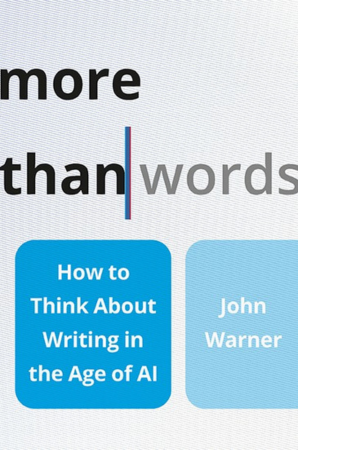
More Than Words: How to Think About Writing in the Age of AI by John Warner. Basic Books, 2025.
This week I made a detailed schedule for myself that would allow me to grade forty-seven essays from my first-year writing students while also working on this book review. I was making progress until I came across essays that may have been created or modified by AI. This has become a regular occurrence, and when I find these essays, I have much to consider: Should I call the student into my office to talk about AI use? Send the case to student conduct? Just grade the essay as is and ignore potential AI use? Answering such questions has slowed down my work tremendously, and I am not alone. Faculty members everywhere are facing similar dilemmas as we decide how to respond to new demands at a time when students can make a few clicks and generate work to submit in our classes.
In More Than Words, John Warner addresses this issue by offering readers a means for contemplating AI and its implications for writing, particularly in the classroom. He does not propose simple or one-size-fits-all solutions, probably because there aren’t any. Instead, Warner examines the separation between the work involved in human writing and what AI can produce so that we can reflect on what and how we teach in order to meet this challenging moment. He encourages readers by suggesting, “Rather than seeing ChatGPT as a threat that will destroy things of value, we should be viewing it as an opportunity to reconsider exactly what we value and why we value those things.”
To consider what we value, Warner has divided his book into four parts that weave personal experiences as a student, writer, and teacher of writing with his research on how AI works and how it compares with human writing. Although it was not the primary takeaway, I learned a great deal about ethical considerations regarding AI use, particularly as they relate to the written works used to train large language models (spoiler: many are used without permission from or compensation to their authors) and the environmental impacts of AI. This is just one example of the scope of the book. There are so many issues to consider, and Warner is careful to cover areas that most need our attention, including those that readers might expect to see, such as how AI works (in chapter 1), teaching writing now and in the future (chapter 12), and how we can respond to AI now (chapters 17–20).
The book is written for a broad audience, but the most likely readers are faculty members and administrators interested in how to respond to the changes AI has brought to the classroom. More specifically, Warner asks instructors to reflect on the assignments they give: If they can be completed with AI, are they really the kinds of assignments we should make? For other readers—who might include members of academic departments, faculty senates, or other groups navigating the challenges AI presents in education—he offers broader questions to help with finding answers thoughtfully.
As readers of Academe, we may want to use Warner’s arguments as a means of advocating for ourselves and our labor. AI can’t do what we do as educators or what we want students to think and write on their own. We need to be able to articulate how what we do is human and valuable, especially in any situation where our work may be outsourced to AI. Calling writing a “fully embodied experience,” Warner comments, “When we do it, we are thinking and feeling. We are bringing our unique intelligences to the table and attempting to demonstrate them to the world, even when our intelligences don’t seem too intelligent. ChatGPT is the opposite, a literal averaging of intelligences, a fearless landscape of pattern-derived text.” He offers an important observation in what is perhaps the most fascinating and effective part of the book, pointing out that our language for talking about human writing versus what AI can produce is insufficient and that we need to reconsider applying the terms for writing to AI. He suggests, “It would also behoove us to stop saying that applications like ChatGPT can ‘read’ and ‘write.’ They ‘produce’ and ‘generate.’ ChatGPT cannot think. It cannot reason. To the extent that we believe this, we are indulging in Baldur Bjarnason’s ‘intelligence illusion.’ If we use this language to describe the technology, we must be clear that we are describing a process that is not the same as human cognition.”
In a similar vein, Warner cites Emily Bender, an AI researcher and professor of computational linguistics, who argues that “the moniker artificial intelligence is a mistake” and proposes that “rather than calling these applications artificial intelligence, we should refer to them as automation.” Once again, this is a means of distinguishing AI capabilities from human capabilities; they are not the same.
Recognizing and identifying such differences is perhaps what Warner does best as he shares relatable stories about teaching and writing. His personal stories matter because they are the antithesis of what AI can produce; their human quality enables us to see Warner in the stories, and we can relate to his experiences as a student, teacher, and professional writer. Such stories are a reminder that writing is a human endeavor, not an automated one, and that our humanity should lead any effort to respond to AI and writing. He encourages us to resist what we’ve been told about the inevitability of AI. Without any quick fixes or step-by-step instructions, he trusts readers to consider the questions he raises and the arguments he presents as a means of discovering answers for themselves.
Leslie Taylor is professor of English at Dalton State College, where she teaches courses in rhetoric and composition. Her email address is [email protected].