


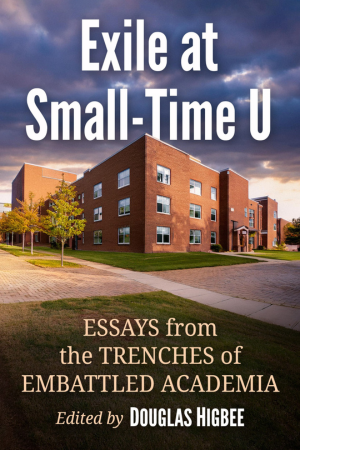
Exile at Small-Time U: Essays from the Trenches of Embattled Academia, edited by Douglas Higbee. McFarland, 2025.
When the online announcements appeared for the forthcoming publication of Exile at Small-Time U, I eagerly looked forward to reading it. Twenty years ago, I chaired Leah Wilkinson’s dissertation in higher education studies on this book’s topic: the work experiences of humanities faculty. Her research investigated the career trajectories of faculty members who received humanities PhDs from Ivy League universities in the early 1970s and how they reconciled the socialization that prepared them for faculty positions at Ivy League institutions with taking faculty positions at less selective rural comprehensive universities as retrenchment began in 1972. I still remember the wistful comment of one humanities faculty member at a rural university who realized that “the best restaurant in town was Subway.” Wilkinson’s dissertation findings highlighted the important role of external research grants offered by public and private humanities foundations, agencies, and learned societies to help humanities faculty members employed at regional public universities and chronically underresourced universities to fund travel and research to maintain their scholarly agendas. As a result of my familiarity with that project, I read with particular interest one chapter in this collection of essays edited by Douglas Higbee, Eugene Stelzig’s “The Not So Good Old Days,” chronicling his 1972 journey from Harvard to SUNY Geneseo.
The website for this book’s publisher suggests that its potential audiences include “current graduate students in the humanities, undergraduate students contemplating graduate school, and their advisors.” I strongly encourage students and faculty at R1 institutions to add this book to their reading lists for accurate and sobering descriptions of the realities of humanities faculty members’ working lives at the vast majority of institutions. I deeply appreciate Higbee’s introduction, which provides an excellent historical overview of the societal and political changes, including retrenchment in the early 1970s, the Reagan-era philosophical shift from viewing higher education as a public good to a private good, steadily declining state appropriations for higher education, and more recent developments that have created difficult conditions for less selective, tuition-dependent, resource-poor institutions.
To be clear, many of the problems and issues discussed by the authors of these chapters are common to all academic disciplines in higher education, not just the humanities: department, college, and institution-level politics (Matthew Boedy’s “Exiled Before I Began”), the psychological toll of commuting to a rural campus (Camden Burd’s “Life on I-57”), autocratic administrators’ ignorance of or willful disregard for institutional policies (Wayne Wisher Combs’s “You Are Going to Be Fired, but I Can’t Tell You Why”), educational gag orders and state-level intrusion on academic freedom and tenure (Derek Charles Catsam’s “Seeking Grace”), and insanely heavy workloads (Erin B. Jensen’s “At Your Service”).
However, the double bind of heavy year-round teaching loads—often with students whose academic underpreparedness significantly increases the labor-intensive nature of the work—and extensive service or advising responsibilities leaves little time for scholarship, which is the “portable currency” necessary to be competitive for jobs at better institutions. Nowhere is this double bind more pronounced than in the disproportionately affected humanities disciplines (with their high ratio of qualified applicants to tenure-track vacancies). The essays in this book are grouped into two categories—before and after tenure—and Kathryn D. Blanchard’s post-tenure chapter, “I Quit,” illustrates perfectly why obtaining tenure at less selective teaching-oriented institutions is often referred to as earning “golden handcuffs.” In her words, “You can keep this job till you’re old and grey! (As long as you’re not stupid enough to say or do something truly illegal.) But—here’s another [thing] . . . that no one talks about—the flip side of security is being stuck. Job interviews come to a grinding halt. Absolutely no one is looking to hire an associate professor.”
I was disappointed, but not surprised, to learn that liberal arts faculty and faculty members in my field (education) have had similar experiences at resource-poor institutions: being told by petty, two-bit academic autocrats that we should be grateful for our jobs. I heard this several times during my twenty years as a tenured faculty member at an underfunded regional public university, and it demonstrates an absence of academic leadership and an administrative perspective that faculty members are problems to be managed, rather than assets to be nurtured.
In sum, this book is not a compendium of complaints by disgruntled faculty members figuratively singing “nobody knows the trouble I’ve seen”; rather, its chapters are thoughtful and provocative essays that collectively provide a balance of nuanced insights into faculty work at the types of institutions that receive media attention only when academic program closures and faculty layoffs are announced. Many of the contributors have written about the unexpected delights of taking the “bloom where you’re planted” approach and discovering shared nonacademic interests with others in their small communities. For humanities faculty members who have won the academic lottery and obtained tenure-track positions, the chapters in this book realistically address the positive and negative practical realities of working at a “small-time U.”
Jim Vander Putten is associate professor of higher education at Mercer University.