


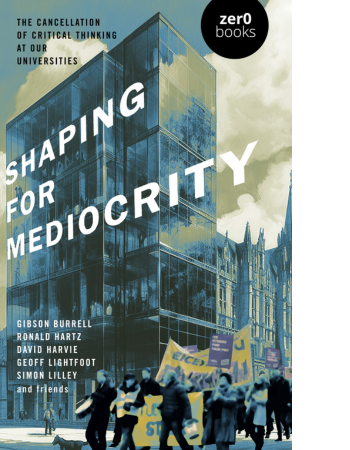
Shaping for Mediocrity: The Cancellation of Critical Thinking at Our Universities by Gibson Burrell, Ronald Hartz, David Harvie, Geoff Lightfoot, Simon Lilley, and Friends. Zer0 Books, 2024.
After decades of warnings about the intensified neoliberal entrepreneurialization of the public university, Gibson Burrell, Ronald Hartz, David Harvie, Geoff Lightfoot, Simon Lilley, and others whom the authors call “friends” show us in Shaping for Mediocrity not only that it’s already here but also how to organize against it.
This book is critically important to those of us organizing against precaritization, artificial intelligence, privatization, outsourcing, and work intensification—just to name a few of the disparate global struggles we’re waging across higher education. Asserting that “these are class struggles” and that “there is an us and there is a them,” Shaping for Mediocrity asks, “Can the university be ours?,” whether it ever was, and how academic workers can play a central role in disrupting the university’s restructuring and the capitalist economy.
Shaping for Mediocrity analyzes the authors’ eight-month campaign in 2021 against the planned redundancy terminations of 145 permanent and temporary faculty members in five departments at the University of Leicester. It guides us through the authors’ strategy for taking on this fight from a class perspective and explains how they used a workers’ inquiry (chapters 4 and 5) into the financialization of the UK public higher education system that is driving precarity. Seeing academic freedom as a thin shield against management rights to hire, fire, and restructure (chapter 6), the authors highlight in their introduction how “universities are sites of conflict, of antagonism, of struggle.” Although they failed to achieve all their objectives—the authors were among the fifteen ultimately dismissed—their struggle shows us how to win.
When University of Leicester administrators released their report Shaping for Excellence, it became immediately clear that their plan for “excellence” meant further subordinating the university to the needs and interests of producing efficient labor power and knowledge for capital—not for the benefit of the working class. The business school was the prime target of the assault, although four departments outside the school were targeted for dismissals. The authors demonstrate that the attack focused on the renowned Critical Management Studies (CMS) program at UofL, which provided a class critique of the field of management, with several authors of Shaping for Mediocrity among its faculty. The campus branch of the national University and College Union (UCU)—whose local leadership overlapped with that of the CMS program—became a secondary prime target, singled out by a vice-chancellor who warned in 2019 that the “Leicester UCU is the most intimidating and disruptive branch in the country.” Administrators wanted to destroy the well-organized UCU branch that, they alleged, repeatedly disrupted the functioning of the university, thereby “constraining management prerogative.” The branch helped organize their campus during multiple UCU strikes and strike threats between 2016 and 2020, used grievances for organizing member power, and launched a global academic boycott of UofL before and during the COVID-19 pandemic and after the redundancies were announced (chapters 1 and 2).
The first four chapters of the book take us through the UCU workers’ inquiry—a process in which workers study current organization of work to identify new tactics and strategies for responding—into how management was reorganizing academic labor to purge areas of critical studies, such as CMS and political economy, while attempting to defang the union. Once the dismissals were announced, the UCU branch was already well positioned to launch a campaign using protests, a short strike, a grade strike, and the international boycott that led many outside evaluators to resign and conferences to be rescheduled. Branch members also launched a clever media campaign using social media and printed posters, postcards, and flyers that included graphics and memes to humorously discredit the restructuring plan.
Ultimately, the authors concluded that they had lost their campaign. Although they called for top administrators to be dismissed, none were. The book’s five authors were among the fifteen employees who made the ultimate sacrifice: They lost their jobs, and some lost their academic careers. And yet, according to author David Harvie in a September 24, 2025, email interview, “if not for the campaign it’s likely this number would have been higher and those workers who accepted ‘voluntary’ redundancy in exchange for an enhanced pay-off would have been forced into agreeing [to] worse terms.” The lesson of their struggle is that academic workers have the power to severely limit, if not to stop, restructuring by throwing a wrench into management’s plans, so long as we have the will to organize and fight.
The workers’ inquiry included a detailed financial autopsy that uncovered the driver of the assault on the faculty (chapters 5 and 6). UofL was unwise to attack business school professors, who were able to critically read the university’s financial documents showing that its indebtedness had been steadily rising and its debt rating declining. The authors anchored their analysis of the driving force for the redundancy attack to the securitization of university assets. UofL financed a new student dorm by using university-owned land as collateral for the loan and using rising student housing fees and other revenue streams to repay the growing debt. This redundancy plan likely served as a means of demonstrating the university’s creditworthiness to its debt holders.
The authors’ research pointed to further evidence of an unacknowledged dictatorship of finance over the public sector—work also being done by the authors of the monumental book Lend and Rule. As public-sector institutions take on increasing amounts of debt, creditors expect neoliberal structuring to maintain the flow of further debt, encouraging debtor institutions to do what is necessary to keep their credit ratings high and their interest payments low.
The authors ask us to ponder the role of the university in a capitalist society as administrative decisions and financial pressures erode both academic freedom and shared governance. Has the UK university system ever been an institution that serves the working class? As in the United States and elsewhere, until the 1960s it was an institution for training children of the ruling class, becoming massified after the student and faculty rebellions of the 1960s and the early 1970s. After World War II, the university system became more deeply integrated into the military-industrial complex by developing publicly funded com-modifiable research for corporations and the state. As the university system was reorganized, the need to discipline new skilled labor eclipsed intellectual growth and expansion of human awareness.
This is the multifaceted thesis of Shaping for Mediocrity. Often trumpeted as “pursuing excellence,” corporatized universities compete by mimicking the same services as other reorganized universities. Such “mimetic isomorphism,” according to the authors, drives what I called the “entrepreneurialization” of the university as a multinational business that maximizes profits (whether from tuition, public funding, corporate grants, or patent and license royalties), reduces labor costs (slashing wages and benefits while increasing productivity, such as through larger class sizes), and expands the flexible workforce (replacing tenure-track faculty members with those on precarious appointments).
If the university was ever ours, it was in theory only. Would it be possible to seize the university and turn it into our own—an institution that serves the struggle against capital? Shaping for Mediocrity asks us to rapidly consider these urgent questions of tactics, strategies, and objectives or continue to risk further defeats.
According to the authors, we have relied on the tarnished shields of shared governance and academic freedom for far too long. Management’s right to manage has eclipsed the traditional right of tenured faculty members to govern. The universities are now thoroughly run by a centralized management that wields power over our proletarianized academic labor. Tenure was abolished in the United Kingdom in 1988 at the dawn of Thatcherite neoliberalism and is disappearing in the United States, where about 70 percent of the faculty are on contingent appointments, and in the Global South.
According to Shaping for Mediocrity, faculty rights to engage in controversial and unconventional forms of inquiry, knowledge, and teaching can no longer be assured by academic freedom when decisions are increasingly usurped from mostly untenured faculties by administrators and outside forces. What use is the paper-thin right of academic freedom, the authors ask, in the face of management’s “right” to manage, a right too many US academic union contracts include?
In the entrepreneurialized university, academic freedom has become a failed compromise with the precaritization of academic labor. Shaping for Mediocrity observes that “a more general employment right—the right not to lose one’s employment—has been lost and replaced with a far more curtailed ‘right’ concerning voicing of ‘controversial’ and ‘unpopular’ opinions, and to question ‘received wisdom.’”
The authors illustrate “that the university is not ours” and “has frequently and increasingly manifested as authoritarian leadership.” They conclude that the “university-as-capital” is “riven with class and class conflict.” It is no longer a fight for rights but instead a multifaceted and intersectional class struggle against “learning” as disciplined labor and research for capital and the state. To reclaim the university as ours means organizing a class struggle on a terrain in which faculty, students, and staff engage as waged and unwaged academic workers in any contest over the control of our labor in the global system of capitalism.
If the university is ours, it’s ours to struggle over. This struggle is needed now more than ever with an outcome yet to be decided.
Robert Ovetz is a precarious senior lecturer in political science at San José State University and an author and editor of four published books and two forthcoming books.