

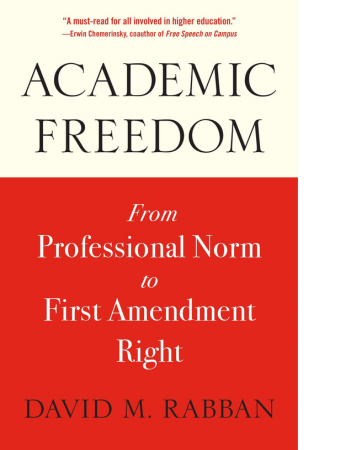
Academic Freedom: From Professional Norm to First Amendment Right by David M. Rabban. Harvard University Press, 2024.
In Academic Freedom: From Professional Norm to First Amendment Right, David M. Rabban provides a comprehensive historical account, doctrinal synthesis, and critical assessment of case law on academic freedom and the First Amendment. Based on that analysis, the book develops a compelling theoretical account of how academic freedom should be understood as a “distinctive subset” of First Amendment law.
The book could not be timelier. The wide-ranging ideological campaign of political interference in higher education in recent years—in which Republican-led states have sought to curtail research and teaching about “divisive concepts,” dismantle diversity, equity, and inclusion programs, and implement sweeping changes to institutional governance—has prompted significant constitutional litigation. That campaign has sharply accelerated under the Trump-Vance administration, whose aggressive use of federal enforcement authority and funding conditions to further pressure faculty members, students, and their institutions into ideological conformity has generated a new wave of high-stakes litigation. As these attacks on higher education continue to proliferate, courts will continue to be called upon to grapple with academic freedom’s constitutional status and doctrinal contours under the First Amendment. For lawyers, judges, scholars, and citizens seeking to navigate these issues, Rabban’s book is an indispensable resource.
As Rabban explains, the relationship between academic freedom and the First Amendment is often misunderstood. While lawyers, judges, and other observers often assume that academic freedom principles derive from the First Amendment’s general commitment to free expression, the historical trajectory has been the reverse. In the United States, academic freedom first emerged in the early twentieth century as a professional standard within universities themselves—well before the development of modern First Amendment free speech jurisprudence and with the AAUP’s founders playing a leading role—to protect the creation, examination, and dissemination of knowledge. Only decades later did courts begin to recognize academic freedom as what the Supreme Court eventually described as a “special concern of the First Amendment” that constrains governmental interference with knowledge creation and academic expression.
The manner of that judicial recognition, however, contributed to a blurring of conceptual categories that has persisted ever since. As scholars regularly emphasize, academic freedom is not simply an individual right to free expression by faculty members. Rather, at its core, academic freedom protects the collective autonomy of faculty members to engage in scholarly inquiry according to disciplinary standards and to do so free from interference by those lacking relevant expertise. As such, academic freedom operates within a framework of professional norms that are distinct from those governing individual freedom of expression in public discourse.
Rabban’s detailed assessment of case law on academic freedom shows that courts have not consistently recognized this fundamental distinction. At times, courts have characterized academic freedom as a distinct First Amendment right of faculty members without explaining how it differs from the general, nonacademic right to free expression. On other occasions, courts have declined to invoke academic freedom where it is clearly implicated, instead applying either general free speech principles or principles governing speech by public employees. Too often, courts have disregarded the distinct concerns arising in academic settings, resulting in distortions of the substantive issues at stake or improper denials of claims to protection.
This doctrinal confusion has been exacerbated by courts’ expansion of academic freedom as a First Amendment concern beyond its original scope as a professional standard. In the United States, academic freedom originally emerged to protect faculty interests in research, teaching, institutional governance, and extramural expression, including from threats by academic institutions themselves. However, the Supreme Court and other courts have developed the notion that colleges and universities, as institutions, may also claim First Amendment protection in the name of academic freedom. To a limited degree, courts also have gestured toward First Amendment protection of student academic freedom.
As Rabban notes, terms like educational autonomy and freedom to learn, rather than variants of the term academic freedom, might “more effectively identif[y] the educational interests that merit distinctive First Amendment protection” for institutions and students. But the confusion is not merely terminological. In expanding academic freedom into a diffuse umbrella concept, courts have rarely acknowledged that the interests of faculty, students, and institutions are distinct or clarified what should happen when they conflict.
These tensions surrounding the interests of faculty, students, and institutions are particularly significant given the forms of some recent federal and state efforts to curtail academic expression. In addition to targeting faculty and students directly, the most aggressive measures—which often go hand in hand with efforts by trustees, donors, and other private actors—have sought to suppress academic expression by pressuring or inducing institutions to implement restrictions through institutional policies. Other measures have served similar ends by seeking to curtail the faculty’s role in institutional governance, long understood as rooted in disciplinary expertise and therefore intertwined with academic freedom.
When institutions resist these incursions, their interests may converge with those of faculty and students. However, when trustees, administrators, and general counsels instead acquiesce, their actions may conflict with the interests of faculty and students. As universities increasingly find themselves caught between political demands and perceived institutional imperatives, on the one hand, and the interests of faculty and students, on the other, questions about whose “academic freedom” takes precedence when these interests collide—and whether institutional interests may override faculty or student claims—become more salient.
Rabban’s framework provides greater doctrinal clarity than existing case law and a strong foundation for protection of academic expression in many concrete circumstances. He considers some traditional, paradigmatic examples, including protection of faculty expression in tenure and promotion evaluations and in academic governance. His framework also holds promise for recent, high-profile examples not discussed in the book, such as the application of Title VI and Title IX enforcement authority to academic institutions. Rabban’s framework may also help to highlight the distinct academic interests implicated in the Trump-Vance administration’s attempts to impose sweeping conditions on government funding for colleges and universities, including (but not exclusively) through the enforced loyalty regime embodied in its proposed “Compact for Academic Excellence in Higher Education.”
Perhaps unsurprisingly, given his extensive prior work with the AAUP, including service as chair of its Committee A on Academic Freedom and Tenure, Rabban outlines an approach to the First Amendment dimension of academic freedom that is largely consistent with AAUP principles. Where he parts company, however, is noteworthy. As a professional norm, academic freedom has historically included protection for faculty members’ “extramural” expression: speech outside their institutions, in nonacademic capacities, that is often unrelated to their disciplinary expertise. Rabban argues that because extramural expression typically falls outside the faculty member’s role as a scholar and teacher, such speech lies beyond the ambit of academic freedom’s protection altogether.
Although the protection of extramural expression has long been controversial, it has also been long and widely accepted and defended on multiple grounds. Scholars’ public engagement is often intertwined with their research in ways not easily disentangled. When faculty members engage in controversial research or teaching, their extramural expression may be exploited as a pretext to target them. Moreover, when institutions sanction faculty members for extramural expression, it can create chilling effects on academic expression. A significant share of the incidents that the AAUP’s Committee A investigates involve reprisals against faculty members for extramural expression. Since Rabban’s opposition to protection of much extramural expression is rooted in his understanding of first principles about academic freedom, not anything specific to the First Amendment, his argument necessarily extends beyond the First Amendment to raise questions about the scope of academic freedom as a professional standard.
Rabban’s framework may not be sufficient to confront the most aggressive attempts to transform the missions and identities of colleges and universities. He would afford considerable leeway for government actors to define the purposes of academic institutions and, therefore, the contents of academic expression within them—for example, by requiring certain courses, creating and supporting institutions with “different goals and programs,” and deciding whether and how much to fund particular programs or institutions in the first place. To be sure, his approach also includes clear limits: While a state legislature could require colleges and universities to offer courses in history, for example, it would violate the First Amendment by going further to “restrict the materials [faculty] could assign or the academic views they could express.”
Such limits rest on the premise that even when colleges and universities are publicly operated or funded, they must be protected as autonomous spaces for independent, critical scholarly inquiry—not treated as instruments for government actors to propagate their own viewpoints. This understanding is rooted in long-standing academic tradition. The AAUP’s 1915 Declaration of Principles on Academic Freedom and Academic Tenure, for example, emphasized that the university must be “an intellectual experiment station” and “inviolable refuge” from public opinion—in contrast to “proprietary” institutions designed to promote the specific ideological, political, or religious doctrines of their founders and sponsors.
As recent events demonstrate, however, political actors may not be particularly committed to this traditional conception of higher education—and when they are not, Rabban’s approach may not adequately constrain them. For example, he states that legislatures may permissibly establish public institutions “designed to promote progressive or conservative educational values” and accordingly may also “transform a progressive or conservative university into its opposite”—expressly invoking Florida’s effort to transform New College of Florida into the “Hillsdale College of the South” to illustrate what might be permissible. The example is a jarring one, for as an AAUP investigation in 2023 concluded, the politically motivated takeover and transformation of New College—which one faculty member at the school described as a “test case for a conservative overhaul of higher education” generally—resulted in widespread violations of academic freedom, shared governance, and free expression for faculty and students.
While Rabban’s specific conclusion might concede too much as a legal and constitutional matter, the example highlights the challenges that will arise if political actors move even more aggressively to transform colleges and universities into the kinds of “proprietary” institutions that the authors of the AAUP’s 1915 Declaration took pains to distinguish from the traditional conception of a university. Some state governments, including in Florida and Indiana, already have moved in this direction—for example, by seeking to recharacterize faculty members’ classroom expression as the government’s own speech, rather than the faculty members’ own academic expression. Federal efforts are following rapidly in those states’ footsteps. To the extent that those incursions are based on arguments that academic institutions or programs created, funded, or subsidized by states or the federal government may legitimately be redefined as essentially “proprietary”—with the government as proprietor—then Rabban’s own First Amendment approach might or might not effectively constrain them.
Ultimately, meaningful protection of academic freedom is unlikely to be found in courts and First Amendment case law alone. As partisan attacks on higher education have escalated during the first year of the Trump-Vance presidency, the commitment of university trustees, administrators, and general counsels to defend academic freedom and the values of their institutions has appeared highly uneven—even when existing legal doctrine has been decisively on their side. They have hardly been alone: Elite law firms, prestige media outlets, and major tech platforms have similarly faltered in defending well-established expressive freedoms, choosing acquiescence, accommodation, and complicity far too often instead. Rabban’s road map to enhance First Amendment protection of academic freedom is a compelling one, but unless colleges, universities, and other civil society actors prove more willing to follow that path by asserting and defending those principles and values—rather than retreating when the road gets rough—the future of academic freedom will remain at risk and uncertain.
Anil Kalhan is professor of law at Drexel University. He is a member of the AAUP’s Committee A on Academic Freedom and Tenure and was a member of the AAUP’s Special Committee on Academic Freedom in Florida in 2023. For the 2024–25 academic year, he was a fellow with the University of California National Center for Free Speech and Civic Engagement.