


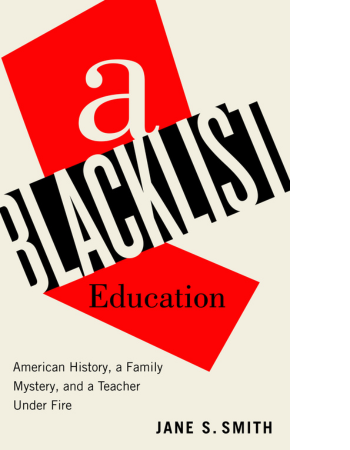
A Blacklist Education: American History, a Family Mystery, and a Teacher Under Fire by Jane S. Smith. Rutgers University Press, 2025.
A Blacklist Education is a short, powerful book about a hidden family story: the interrogation of Jane Smith’s father, Saul Schur, in the early 1950s for an alleged affiliation with the Communist Party. Starting from this very personal event, the book expands to consider how the New York City public school system, the largest in the country, became a target of conservative zealots, part of a pervasive national movement to suppress liberal voices.
A dedicated public school teacher, Schur was named as a communist by anonymous informers; he was one of many teachers who voluntarily left the school system in 1953 rather than have his family become the object of McCarthyite attention. His experience was never mentioned as Smith was growing up. It is only as an adult, while sorting through family papers after her mother’s death, that she encounters intriguing evidence of this hidden chapter in her father’s life. She finds a thick folder stuffed with photos, letters, newspaper clippings, and other documents that she can’t account for. Her father, a Boy Scout troop leader? A political activist? Accused of Communist Party membership? How had she never heard of any of this? Mystified, but with no one to ask for an explanation (her father predeceased her mother by many years, and her brothers don’t seem to know much), she launches an investigation of her own. This is the “education” of her title—her own search to understand the blacklist’s impact not only on her father but also, beyond that, on the politics of the city and the nation.
As she pored over the files of anticommunist investigations in the archives of the New York City Board of Education, Smith says, she “felt the past rush up to meet me in an assault of sensory memories.” The book makes sense of these childhood memories in the light of the history she is now learning. The combination of personal testimony and historical context makes for fascinating and moving reading. There is no other account like it in the many written histories of this period.
An experienced historian with some prizewinning books to her credit, Smith sought out archives and immersed herself in the history of anticommunist movements dating back to the 1920s, learning about how laws in New York State in the 1940s and 1950s that made Communist Party membership of public employees the grounds for dismissal echoed the national Cold War agenda. She finds out that her father’s membership in the New York City Teachers’ Union was one of the reasons given for the accusations against him. But, even more, it was probably what he must have considered responsible actions that labeled him a dangerous radical in the eyes of politicians and the board of education: reports to the authorities about corruption at the high school where he taught (the principal hired teachers he didn’t need in order to inflate the numbers of students enrolled and thus increase his salary and pension); denunciation of an openly fascist colleague (who taunted and physically abused Jewish, Italian, and Black students and recruited white students for the German-American Bund); his leadership of the PTA at his children’s school (demanding an end to overcrowding, agitating for new school buildings). Smith comments that as her father acted according to principles of honesty and equality, demanding improvements for children and their teachers, those in charge of the schools were compiling “a silent dossier,” defining his activities as subversion. Her research uncovers documents Schur was certainly unaware of until they became the grounds for summoning him to an interview by the board of education’s chief investigator, Saul Moskoff. Even then, it’s unclear if he was allowed to see any files they had on him. Suspected communists could not have lawyers in these interviews; they could be accompanied only by a fellow teacher-advocate, usually a union representative also under investigation or already fired. The advocates had no legal status entitling them to see evidence being used against an accused teacher. It’s possible that Jane Smith learned things about which her father had little or no idea.
The portrait of Saul Schur is impressive: an ordinary man who stuck to the principles of honesty and civic responsibility taught to him by the very school system that now turned against him—and whose activism on behalf of students and teachers clearly led to accusations of subversion. He took on the grand inquisitors with defiance. Like the teacher he was, Schur demanded logical and factual answers to the questions he threw back at the man in whose hands his fate would rest. Smith devotes an entire chapter to her father’s interview. The documents she has amassed bring these moments to life in gripping detail. In his interview, Smith’s father was adamant and combative. Is the board of education interested in all subversives? What about fascists as well as communists? he asked, reminding Moskoff of the case of Schur’s colleague, the Bund supporter whose mistreatment of Black, Jewish, and Italian students he had reported. Moskoff replies vaguely that all subversion is of interest but repeatedly reminds Schur that it is he, Moskoff, who is asking the questions. Schur persists, and Moskoff rebukes him, threatens him with insubordination, and comes back again and again to the only thing that concerns him: “Are you now or have you ever been a member of the Communist Party?” Had the answer been yes, the request for names of others would have followed.
The richness of this book is manifold, not least because of the portraits Smith offers of some of the principal players in the witch hunts they sponsored. The combination of national, local, and personal detail brings this period in history to life. Without direct connections to the federal investigators, but enabled by state laws, the New York City Board of Education created its own machinery. The superintendent of schools, the “progressive educator” William Jansen, takes on the crusade with a vengeance. Smith suggests that his thinking was shaped by local influences: “Politically powerful and deeply conservative New York City Catholics both within and outside the school system,” among them George Timone, a member of the board of education tightly connected to the bishopric of New York.
These prominent Catholics surely had Jewish teachers in their sights; the connections between subversion and Jews were part of the lore of the McCarthyite inquisition. That is why it was particularly useful to have Saul Moskoff, a practicing Jew, hired to conduct the New York City purges, as a cover for their antisemitism. His list of suspected communists came from informers, usually teachers under interrogation, who had complied with the requirement that naming names was the only proof that one had renounced communism. Smith’s research turns up this priceless tidbit: Moskoff was apparently worried enough about ethical religious challenges to his mission to seek assurance from several rabbis. In 1953, he wrote to them, “I am Assistant Corporation Counsel of the City of New York assigned to investigate the extent of infiltration by Communists into our school system and to institute disciplinary proceedings where the facts warrant it. . . . Several trials are pending, and I have reason to believe that Talmudic admonitions with respect to informers may be invoked in the forthcoming trials against certain teachers who are suspected of membership in the Communist Party. I would like your expert advice as to whether or not . . . the Talmudic law [can] properly be invoked by a person who has been asked: ‘Are you now or have you ever been a member of the Communist Party?’” The rabbis apparently demurred, leaving Moskoff to justify his role as grand inquisitor on his own. Smith writes,
Moskoff’s spiritual scruples did not keep him from pursuing his quest for subversives or from turning his investigations into stylized dramas of sin and possible redemption, preferably through self-flagellation. What happened inside Moskoff’s office was a secretive ritual that began in assurances of confidentiality and proceeded quickly to unattributed accusations that could be erased only by “cooperating,” which meant informing on others. Cooperators could return to ordinary life, although always with the ominous warning that they might be called upon again. Non-cooperators saw their interviews end abruptly, the first step in a process that meant the end of a teaching career. If teachers continued to be “insubordinate,” which included not just refusing to answer questions but also refusing to resign or retire from their jobs, Moskoff referred them for disciplinary hearings before the Board of Education’s trial examiner, Arthur Levitt. Here again, the Board of Education seemed careful to have Jews prosecuting Jews, to avoid charges of antisemitism.
Sadly, this trope of the Jew serving powerful antisemites has a long and ugly history—one confronting us again now, as the right-wing campaign to dismantle democratic higher education is served by Zionists whose conflation of criticism of the state policies of Israel with antisemitism has created a wave of hysteria similar to, and even more destructive than, the anticommunist campaigns of the 1950s.
A Blacklist Education is a reminder that democratic public education has long been a difficult project to accomplish. Then as now, those defending it have paid a heavy price. Smith’s father quietly resigned his position—a kind of forced retirement—and opted to protect his children from any knowledge of the reasons (hence the reference to “A Family Mystery” in the book’s subtitle). What must it have been like for Schur to effectively cancel some chapters of his history? As she does her research, Smith remembers veiled references that make sense only retrospectively in light of the research she is pursuing. One of those references involved a meeting at what her father evasively described as a reunion of City College alumni but was more likely a celebration of some court victory, won years later for the fired teachers. These victims of the red purges maintained networks of connection for years, showing up for one another in myriad ways—helping the unemployed find jobs, attending celebrations of small political wins, meeting at funerals.
Saul Schur was one of the several hundred or more public school teachers who left the New York City school system in that period; some were fired outright, while others, like him, simply disappeared from their schools. Most found other jobs. Schur worked as a consumer education consultant for Seventeen magazine. Smith adds that “one teacher found work in a Christmas card production shop before becoming a remedial reading teacher at a private school. Another became a salesman for a company selling very early versions of computers, a job that paid much better than teaching but that he hated. When he died decades later and his children were asked his profession, they answered in unison, ‘he was a teacher.’” The inquisition might take away the jobs of these people, but their identification with their calling remained.
Reading A Blacklist Education is not an exercise in nostalgia. We are again confronting a massive attack on the very foundations of democratic education and, this time around, the stakes feel even higher. In the 1950s, the targets were individual teachers (communists, progressives, liberals) and their left-wing union; now it is the system itself that is being dismantled, its value as a public good redefined as a matter of individual parental choice (through vouchers, charter schools, and homeschooling, all to be paid for by public funds). As commitments to principles of equality and justice—to say nothing of truthful accounts of history—are trashed, in their place we will have officially sanctioned stories of violence and greed offered to glorify our nationalist destiny.
Jane Smith does not offer us a way of combating this latest assault, but her analysis of the factors in New York City’s purge of some of its finest teachers gives us a way of trying to understand it. Her book is a carefully wrought analysis of power and of different kinds of resistance to it. A Blacklist Education reminds us that the stakes we have in a democratic system of education are always under threat and that, for those of us who value it, the fight for its preservation is a never-ending challenge.
Joan W. Scott is professor emerita in the School of Social Science at the Institute for Advanced Study in Princeton, New Jersey. She is a long-serving member and past chair of the AAUP’s Committee A on Academic Freedom and Tenure. Among her recent books is Knowledge, Power, and Academic Freedom.