


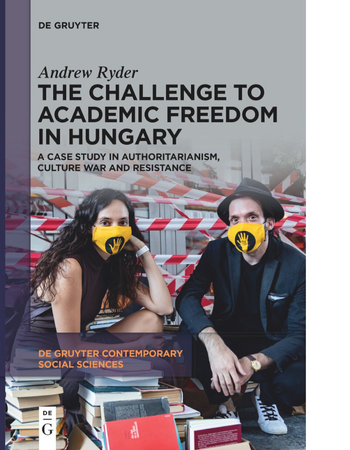
The Challenge to Academic Freedom in Hungary: A Case Study in Authoritarianism, Culture War and Resistance by Andrew Ryder. De Gruyter, 2022, paperback reprint 2024.
In a recent interview David Pressman, the US ambassador to Hungary from 2022 to 2025, responded to Vice President JD Vance’s praise for Hungary’s conservative higher education “reforms” by stressing that they were “not an attempt to address cultural issues around conservative voices or liberal voices, but . . . an attempt to take assets and transfer them from the public purse to private pockets.” He concluded that “what’s happening in Hungary isn’t conservatism, it’s corruption.”
Pressman’s point is elaborated in Andrew Ryder’s revealing study of how the regime of Hungarian strongman Viktor Orbán has transformed the country’s higher education system. The book was first published in 2022 as an expensive hardcover, but a recent paperback edition makes this important work more broadly available. It’s quite timely, given that US readers will see in its pages many striking parallels with the attacks on higher education institutions launched by Donald Trump—and, hopefully, also find some useful lessons on how best to resist them. Ryder, a British national who has taught in Hungary for more than two decades and is married to a Hungarian, emphasizes—like Pressman—that Orbán’s assault on academic freedom, indeed on the academy itself, has not only been part of a right-wing nationalist culture war but is also in crucial respects a product of an “audit culture” characteristic of academic capitalist privatization.
Following two introductory chapters that present a definition of academic freedom, a brief survey of the history and structure of the Hungarian university system, and some background on the author’s own remarkable journey, the book devotes a chapter each to five key struggles that marked the Orbánist takeover. The opening salvo was the attack, discussed in chapter 3, on Central European University, founded by Hungarian American investor and philanthropist George Soros. The so-called Lex CEU of 2017, described by CEU Rector Michael Ignatieff as a “masterpiece of legal mugging,” was strikingly similar to measures enacted two years earlier in Russia against foreign NGOs. To protest a series of decrees ostensibly regulating foreign higher education institutions but clearly intended to push the CEU out of Hungary, an estimated eighty thousand people took to the streets of Budapest, briefly establishing the Szbad Egyetem (Free University) in Kossuth Square in front of parliament (see Joan W. Scott’s November 2018 Academe Blog post “The Central European University Under Siege”). But the CEU administration stood aside from the protests, instead playing “a cat and mouse game” with the government before ultimately abandoning Budapest for Vienna.
The next assault was more directly linked to the culture war. In chapter 4, Ryder recounts how in 2018 the government ordered universities to terminate degree programs in gender studies, offering two justifications (see also David Paternotte’s article “Gender Studies and the Dismantling of Critical Knowledge in Europe” in the fall 2019 issue of Academe). The ministry claimed that there was no demand for these programs on the Hungarian job market, even though many graduates had remained in the country and embarked on successful careers related to their studies. Perhaps more central was the claim that the programs were “not compatible with the Government’s conception of human nature.” This placed the move in the context of a patriarchal offensive aimed at nontraditional gender relations dating to Orbán’s 2010 accession to power.
The next assault, the focus of chapter 5, was directed against the Hungarian Academy of Sciences (HAS). Founded in 1825, it became a state institution under Communism, but even in those days it was something of “a refuge for researchers critical of the regime.” After 1989, HAS emerged as “an important voice in the intellectual life of the nation,” with a network of fifteen institutes and 150 research groups employing about five thousand researchers. Still, like similar institutions elsewhere, it was marked by latent conservatism, and its leaders were politically cautious. In 2018, the regime enacted a “reform” that transferred leadership to a new board appointed by the responsible ministry and moved its budget to ministry control, in effect kneecapping HAS’s previous autonomy. The result was predictable. As one anonymous scholar testified, “At the moment there are few cases of individual academic rights being overtly violated but there is now a culture where managers warn their team members that a certain research topic may make problems and ultimately the proposal is dropped. You could say there is an element of self-censorship where a fear for future funding allocation or career advancement makes some fall into line or become more careful and cautious.”
As chapter 6 explains, the 2018 restructuring of Corvinus University, established in 1934 and among Hungary’s most prestigious institutions, had little to do with the culture war. In essence, the university was privatized and restructured as a foundation, with dramatic effects on its curriculum and faculty. Its income is now derived not from state allocations but from the dividends of a stake provided in major Hungarian companies. In 2019, the state appointed a Bulgarian businessman with ties to Orbán and the McKinsey consulting firm to the newly created post of university president, and a new board of trustees was established. The university’s traditional governing bodies, including its senate and faculty councils, were either reduced in power or eliminated. Faculty members and other employees lost civil service status. According to one professor, “The model change has made the university feel like a multinational company. . . . Universities like the Corvinus are becoming a mirror of the situation of the wider society, dominated by an authoritarian leader. However, it is authoritarianism with a streak of incompetence.” Sound familiar?
Opposition to the Corvinus takeover was largely muted, but tensions associated with the previous assaults came to a head with the 2020 student rebellion at the University of Theatre and Film Arts in Budapest (SZFE). Chapter 7 tells the story of the Free SZFE movement, in which students (and some faculty supporters) occupied the institution, one of the oldest in Hungary, after the government announced plans to include the school in a privatization program. It was probably the most sustained instance of resistance to the Orbán agenda, even if it failed in the end. The occupation unfolded during the height of the COVID-19 pandemic, and public health restrictions ultimately compelled the occupiers and their supporters (Ryder included) to end the protest. Nonetheless, Ryder concludes that “the most significant thing about the protest was that the border between teachers and students was broken through. . . . To some extent, this experience changed me. I understood that I have rights and I learnt how to stand up for them.” Even unsuccessful protests can have their benefits.
Ryder’s accounts of these events are richly supplemented by testimonies provided in each chapter from “dissenting voices.” These, as well as three “critical reflections” on the broader context by Hungarian scholars in chapter 8, provide a variety of perspectives not only on events in Hungary and their significance for scholarship and teaching. They are arguably the most important parts of the book, offering critical advice about the nature of protest, the need for pragmatism and alliances, and the role of individual heroism.
US scholars should heed two insights from the book as we organize to resist our own version of Orbánism. First, “It does not work when people do not robustly protest,” as one former researcher at the Academy of Sciences writes. “People need to organize in an open way, attempts to have behind-the-scenes negotiations, and to make backroom deals that do not have satisfactory endings is not the best strategy. . . . Elitism is a problem of science worldwide. However, our scientific institutions are not attacked because of it, but because of the inherent nature of science itself, as it serves as a mirror to the society and authoritarian politicians.” Second, “Critical thinkers need to take care in the search for something better,” sociologist Miklos Hadas warns. “A quest for purity can hold the danger of generating hate and inflexibilities that fragment progressive alliances and which can play into the hands of authoritarian populists allowing them to frame themselves as the defenders of national identity and tradition against an unreasoning and strident left.”
The central theme of the book, however, is how neoliberal privatization and marketization undermine academic freedom and autonomy and thus, as scholars like Wendy Brown have argued, prepare the way for the authoritarian nationalism and anti-intellectual populism of the Orbáns and Trumps. The experience of Hungary illustrates how reactionary campaigns against higher education are not only a response to the rise of academic capitalism but also in some ways a fulfillment of that program. In Hungary authoritarianism and neoliberalism have arisen, as Ryder notes, “in tandem.”
An afterword by legal scholar Andras Pap perhaps puts it best. Academic freedom, he writes, “is situated within the Scylla and Charybdis of neoliberalism and illiberalism. . . . The Hungarian case, as demonstrated in Ryder’s book, shows that (neo)liberal and illiberal threats can even be combined and cumulative.” The implications for US higher education are, I think, plain to see. We have been warned.
Henry Reichman is professor emeritus of history at California State University, East Bay, a former AAUP vice president, and a former chair of the AAUP’s Committee A on Academic Freedom and Tenure. He is the author, most recently, of Understanding Academic Freedom, published in its second edition earlier this year.