


According to one theory, we are in the midst of the Fourth Industrial Revolution. In this account, advanced by Thomas Philbeck and Nicholas Davis of the World Economic Forum, analog machines replaced human labor in the First Industrial Revolution, the railroads and telegraphs served as global analog networks in the Second Industrial Revolution, digital information and communication technologies emerged in the Third Industrial Revolution, and our current era is characterized by cloud computing, gene editing, global platforms, and artificial intelligence.
While simplistic, this categorization usefully frames the primary purpose of technologies as economic drivers in capitalism, providing a counterpoint to narratives that present technologies as forces of social good. In capitalism, technology can indeed have social benefits, but only when those benefits are subordinated to the economic benefits the technology can bring to its owners. When these goals are not aligned—that is, when a profit-increasing technology is introduced whose social value is not readily apparent—capitalists can expect some resistance, which makes it important to mobilize narratives that try to convince us of the technology’s “inherent” social good.
We can see these dynamics currently playing out in the case of artificial intelligence, which is framed in pseudomystical terms as an almost divine technology that will solve all of our problems. It is therefore helpful to keep in mind the view of AI as an engine of the Fourth Industrial Revolution—in other words, as a tool intended to make production more efficient and to maximize profits by replacing or “supplementing” human labor with machine labor, as happened in the First Industrial Revolution.
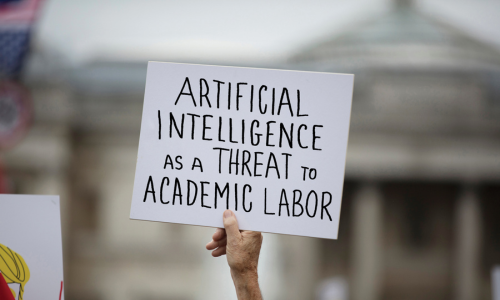
The introduction of AI into academia must be understood as part of these capitalist processes, and arguments about using AI to improve education and academic research should be examined in that context. How is artificial intelligence reinscribing academic labor in ways that privilege certain economic interests? Who benefits from the creation of economic value that is generated by the insertion of AI in academia? And how is AI reshaping the relationship between teachers and students in ways aligned with these new forms of value?
Admittedly, these are questions associated with what we might call a critical perspective. But there are good reasons to be critical of AI at this juncture, particularly when it comes to generative AI (GenAI). GenAI is a technology controlled by a handful of corporations whose leaders have become aligned with a far-right ideology, and it is financed through a speculative bubble that increases inequality. GenAI replicates social biases and will never cease to include errors in its results. It is environmentally harmful and is resulting in a shrinking labor market for our graduates. Researchers are also suggesting there might be a link between AI usage, diminished critical-thinking skills, and cognitive decline.
For these reasons, it is important to question how AI, and particularly GenAI, fits into the mission of the university. In my opinion, the introduction of GenAI into academic labor could have at least three concerning implications: an increase in productivity expectations, a deterioration in the integrity of research, and a further alienation of the relationship between teachers and students. In other words, GenAI could continue the trends of demanding more work, offering fewer resources, and decreasing the quality of education through automation—all while asking us to accept crucial concessions to the foundations of academic integrity.
The Plagiarism Machine
Admittedly, GenAI can be a great tutor for specific subjects (like math) and under certain conditions (to expand the capabilities of, not to replace, human teachers). There is a growing perception that if we can get students to use GenAI for tutoring purposes, and not for cheating purposes, we will be able to avoid a crisis.
This, unfortunately, is not sound reasoning, because the core of GenAI is incompatible with academic integrity. The apparent suicide in December 2024 of former OpenAI engineer Suchir Balaji, who was identified as someone who could deliver key testimony regarding ChatGPT’s violation of copyright law, is a tragic reminder that there are important unresolved questions about how GenAI acquires its training data. Colleges and universities seem to be turning a blind eye to these questions, even as lawsuits are mounting against GenAI companies for copyright violations.
My main concern is that by encouraging the adoption of GenAI, we are directly undermining the principles we have been trying to instill in our students. On the one hand, we tell them that plagiarism is bad. On the other, we give them a plagiarism machine that may reduce their chances of getting a job, damage the environment, and widen inequality gaps in the process.
As we learn more about how the technology actually works, we are realizing that GenAI is nothing but statistically derived plagiarism. Researchers at Apple have demonstrated that large language models merely do a form of “sophisticated pattern matching.”
GenAI can’t reason, it doesn’t know anything, and it can’t think intelligently. It simply takes vast amounts of content created by us (text, music, images) and uses complex mathematical models to come up with a product that is, statistically speaking, the best match in response to our query. It’s a neat, albeit energy-consuming, trick.
An important part of the trick is that the end product must not directly reference or look too much like the original material. But the fact that the model is intentionally manipulating source material to camouflage its provenance is itself a kind of plagiarism. In academic lingo, this approach is referred to as crafty, cunning, deceptive, or disguised plagiarism. We admonish students who engage in such behavior.
AI companies acknowledge that they would not be able to operate without our original copyright-protected material. They conveniently claim, in a number of court cases, that what they are doing is not plagiarism. But they are wrong.
When considering these cases, we may be tempted to look too narrowly at the mechanics of plagiarism: Since the result is not a word-for-word copy but a “derivative outcome” that constitutes “transformative fair use,” defendants (like OpenAI) claim that it is not plagiarism. But instead of focusing on the end product, we need to focus on the social relationship between the plagiarizer and the source content. Plagiarizers take someone else’s content and try to pass it off as their own. That is exactly what these companies are doing, regardless of whether they are using a single source or many, and in spite of their sophisticated paraphrasing.
Literature and cultural studies professor Zac Zimmer writes, “Citation is the coin of the academic realm, so anything that degrades the credit-granting mechanisms of academic citation and reference would be antithetical to the pursuit of academic knowledge.” Why would we, as institutions of higher learning that try to instill in students a sense of academic integrity, embrace a plagiarism machine? Why would we endorse the narrative, peddled by GenAI companies, that they must be granted blanket permission to take our content to train their plagiarism machines?
As academic workers, we always build on the work of others to create new knowledge. Integrity is crucial to this process, not only because proper citation is the honest thing to do but because without proper attribution it is impossible to contextualize knowledge and test the soundness of new ideas. By plagiarizing, GenAI breaks this process, which makes it difficult for us to teach our students to become learners and thinkers who are situated in a historical and social process.
There’s also a future concern we need to address. At the moment, the use of GenAI is free or relatively cheap. Following a model established by so-called industry disruptors, AI companies are letting us use their tools for free at first. Why? Because they are using our interactions with their platforms to improve their technologies (in other words, we are providing free user testing) and in the process get ting us to become increasingly dependent on their services.
At some point, this largesse will stop. AI companies will start charging a hefty subscription fee (OpenAI just rolled out a $200 per month “pro” plan) or, as we have seen in past cases, demand that in exchange for their free services users surrender more and more of their personal data to feed the machines. Does the university have an obligation to protect students against this future form of dependency? Tying the production of knowledge to a subscription service introduces inequalities into academic inquiry by favoring those who can pay the monthly fees, as we have seen in the case of libraries that can’t afford expensive journal subscriptions.
The End of the Written Assignment
Last year, I was still somewhat confident I could detect assignments written by AI. This year, as GenAI models get more sophisticated, and as students learn new tricks, I’m not sure I can detect its use in my classes anymore, even with the aid of technology. According to some studies, about a fifth of students are using GenAI to cheat. Like many of my colleagues, I am tired of and resentful for having to spend so much extra time checking for AI plagiarism, even while our campuses embrace AI to make themselves seem cutting edge.
Experts tell us there are ways to manage this problem. They say we can teach students to integrate GenAI into their coursework responsibly. They say we should scaffold assignments and perhaps place less importance on the written essay. Maybe it’s time to replace the written essay with more active pedagogical tools, they say.
Maybe they are right. But I’m not even sure whether alternative pedagogies, prevention, or detection matter anymore. Two kinds of disastrous effects have already been unleashed by the use of GenAI in our classroom.
First, writing as a practice is being redefined. As renowned literacy studies scholar Walter Ong argued, writing represents a unique opportunity to exercise abstract thinking. If GenAI is corrupting students’ ability to write (and to read, since they can now ask GenAI to summarize their readings for them), it also could be undermining their ability to generate ideas by thinking theoretically and conceptually.
Second, the net effect of the introduction of GenAI into the classroom is to undermine trust between teachers and students. It’s like stepping into a strange dream where objects that appear to be real are not. My ability to assume that any student is the author of their work has been seriously compromised. This is probably not fair to the majority of my students, which is unfortunate. GenAI is redefining trust relations between students and teachers in a way we didn’t ask for, which is reshaping academic labor.
AI as Research Assistant
Our research practices are bound to be transformed as well. According to the marketing teams of AI companies, the use of AI in research promises to revolutionize human knowledge and bring about unprecedented levels of productivity. And yet, as Lisa Messeri and Molly Crockett have pointed out in Nature, there is a real danger of creating scientific monocultures that pursue only the kind of research that can be answered with AI, resulting in a type of scientific inquiry where we “produce more but understand less.”
Messeri and Crockett identify distinct imaginaries already at work in shaping how we think of AI in academic work. According to these narratives, AI can act as an oracle, summarizing and communicating scientific knowledge for us. It can act as a surrogate, conducting research on our behalf or even generating synthetic data where actual data are too costly to collect. AI can act as a quantitative analyzer, digesting vast amounts of data, and even as editors and peer reviewers of the journals where research is published. Thus, from ideation to production to publication, AI is imagined to be a helpful delegate. But delegation always introduces risks, which are greater in the case of a technology prone to errors and hallucinations. In this context, holding on to ways of doing academic work without AI might be not just a Luddite affectation but a way to protect our intellectual legacy from processes that can easily corrupt it.
The Self-Destruction of Education
A good indication of the true intentions behind the promotion of GenAI should be the character of the people behind it. Are the CEOs and government officials promoting AI known for putting people before profits, for embracing science to meet the challenges of our times, and for using the power of technology to democratize our societies—or the opposite? Take, for example, the Presidential AI Challenge, which states that “early training in the responsible use of AI tools will demystify this technology and prepare America’s students to be confident participants in the AI-assisted workforce, propelling our Nation to new heights of scientific innovation and economic achievement.”
But beyond the obvious contradiction between what AI supporters say they want and what their actions reveal, why would academia go along with the use of a tool that undermines academia’s own existence?
Sadly, educational institutions have been implicated in their own demise for decades. In fact, according to theologian and philosopher Ivan Illich’s searing critique of education in his essay “Ritualization of Progress,” schools serve precisely as the sites where the contradictions between what capitalism promises and what it actually delivers are normalized. In Illich’s view, the goal of formal schooling is to make citizens governable by institutions, literally teaching them their place in society and manipulating them into accepting a preordained hierarchy of classifications associated with one version of what constitutes progress.
Viewed from this angle, the introduction and promotion of GenAI on campuses is intended to indoctrinate large sections of society into accepting the potential replacement of their own human labor with cheap and inaccurate machine labor, consenting to the sacrifice of the environment in order to power AI systems, and acquiescing to the social inequalities that come with these sacrifices. Ultimately, it also means accepting that education itself can be automated and made more “efficient” through the use of AI by students and teachers. This is what I mean when I say that schools can be directly implicated in their own demise, engaging in practices that lead to undermining academic integrity, reducing human contact, and eliminating opportunities for critical thinking. Our worst nightmare should be a vision of an educational system where teachers use AI to pretend to teach and students use AI to pretend to learn.
Should We Ban Generative AI?
Educators are sometimes too quick to adopt the latest and “greatest” technology, even when there is evidence that profits trump pedagogy. It’s easy to buy into the hype when GenAI companies themselves generate lesson plans and educational activities to get educators to adopt their products (these materials have been criticized for essentially being little more than sales pitches). But calling for an absolute AI ban on campuses would be unrealistic. So, what might be proposed instead?
For starters, colleges and universities could commit to matching every dollar they spend on AI integration with a dollar spent asking critical questions about AI. This means promoting work, inside and outside the classroom, that explores some of the issues I’ve raised here, as well as any kind of critical perspective on AI.
It has become clear recently that some students are just as concerned about the impact of AI as we, their teachers, are. They are already seeing evidence that AI will be used to reduce employment opportunities in their fields and undermine their labor power. Many students in the creative and computer science fields see GenAI as a threat, and rightly so.
Which is why, as a second step, colleges and universities should adopt transparency measures that would allow students to make informed decisions about the consumption of AI on campus. If some professors are going to demand that students refrain from using GenAI in their assignments, students have a right to demand the same from us. Through catalog or syllabus information, students should be able to identify “AI-free” courses: classes where the instructor refrains from using AI to grade work, plan lessons, or produce content. This is not a perfect solution (especially when it comes to required courses), but it’s a start. At the very least, we should demand mutual disclosure and transparency on the part of students and faculty in their use of AI tools, as I am trying to do with the implementation of AI tags. If the core of our mission is to engage in the production of knowledge with integrity, the identification of human versus machine-generated or machine-aided courses is a way of invoking that integrity.
Equally important, students and instructors should have the right to demand that the university refrain from using data collected from their learning activities to train or operate AI models, whether the institution’s or a third party’s. This right to opt out should be enshrined in data privacy policies and accompanied by the appropriate verification mechanisms.
One example of this is the petition we launched at SUNY Oswego that demands that faculty members, students, and staff be allowed to withdraw their consent for the university and its third-party service providers to use our data for any purpose related to GenAI without our explicit consent. While we may have previously granted the university permission to use our digital data for learning activities and the administration of the institution, that consent cannot and should not be extended to applications that were not described in the original agreement, such as GenAI systems. We invite anyone to reuse the text of our petition to create a similar initiative at their own institution.
Acts of dissent such as these would fundamentally alter the relationship between higher education institutions and AI companies that have been providing “low-cost” services to colleges and universities in exchange for data generated by us to train their AI models. It is time to challenge the legality and ethics of this form of extractivism, and GenAI provides us with a good opportunity to do so.
In the few years since its popularization, GenAI has dramatically transformed our profession, demonstrating that academic labor is far more than what is captured by the “research-teaching-service” model. Our work requires a constant examination and critique of the tools we use, with one eye to their possibilities and the other to their threats. As AI transforms academic labor, much more is at stake than the terms and conditions of our employment. What is at stake is the very integrity of the teaching and learning process, and the notion that all humanity—not just a few individuals—should benefit from the production of knowledge that happens at our universities.
This article was adapted from commentary published on the Future U blog.
Ulises A. Mejias is professor of communication studies at SUNY Oswego and recipient of the 2023 State University of New York Chancellor’s Award for Excellence in Scholarship. His latest book, coauthored with Nick Couldry, is Data Grab: The New Colonialism of Big Tech and How to Fight Back (University of Chicago Press, 2024).