


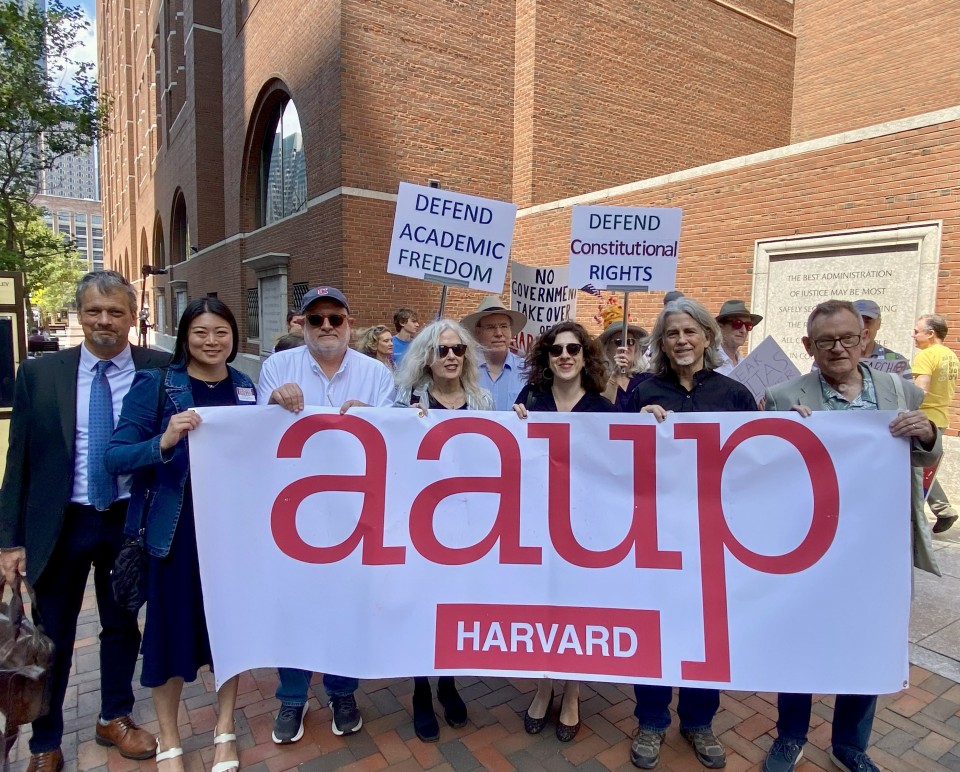
Faculty members at Harvard University formed the AAUP–Harvard Faculty Chapter (AAUP-HFC) in June 2024, prompted in part by the university’s denial of diplomas to thirteen graduating seniors who had participated in pro-Palestinian encampments. Since then—and particularly since the second Trump administration began a punitive campaign against Harvard specifically, and against scientific research and academic freedom more broadly—the chapter has experienced extraordinary growth, increasing membership by more than 600 percent in the first half of 2025.
The AAUP included Harvard faculty members in its first published list of members in 1916, and a 1917 list notes that a Harvard member was chair of a Boston-area regional AAUP group. Other records document Harvard AAUP chapter activity dating back to 1932. In the late 1940s and early 1950s, the chapter mobilized against McCarthyism, defending Harvard physicist Wendell Furry when he was targeted by the House Un-American Activities Committee. After decades without an AAUP chapter on campus, members of the new AAUP-HFC are energetically protecting the interests of faculty and the campus community through activism and litigation.
We learned more about the chapter from executive committee members, including President Kirsten Weld, Vice-President Walter Johnson, Secretary-Treasurer Nikolas Bowie, and at-large members Vincent Brown, Ryan Doerfler, and Richard Thomas.
How has AAUP-HFC managed to organize and expand its membership so rapidly?
Three conditions informed the chapter’s rapid growth: first, a long-brewing frustration with the absence of faculty governance at Harvard; second, our administrators’ thought-policing and punitive responses to student activism and critical thought over the last two years; and third, the extraordinary assault on higher education—and our university in particular—unleashed by the second Trump administration.
Compared with some peer institutions, Harvard is highly decentralized, with eleven schools that are functionally and financially autonomous, plus an array of affiliated hospitals that are even more so. That’s made it easy for university administrators to keep faculty isolated and to concentrate power at the top in the Harvard Corporation: a self-perpetuating body of individuals with minimal connection to campus life or academia. When the corporation, in 2024, overruled the duly enacted legislation of the Faculty of Arts and Sciences and denied a group of graduating seniors their diplomas as punishment for their peaceful protest activity, that was the last straw. We felt it was our responsibility to organize our colleagues in the service of a more democratic university.
When we formed the chapter in the summer of 2024, we had no idea that Trump would be reelected, or that his attacks on higher education would be so intense, or that our institution would come to occupy such a large role in that story. But the fact that we had already done the work to establish the chapter meant that we had a structure in place when a response became necessary. The previous year had seen a great deal of campus turmoil, including aggressive doxing of pro-Palestinian students and faculty, the promulgation of absurdly restrictive limits on free expression regarding Israel and more generally, and the corporation’s ouster of President Claudine Gay over the express objection of more than seven hundred faculty members. All of that demonstrated two things very clearly: First, there was a lot of dissatisfaction among Harvard educators that was waiting to be tapped, and second, the ad hoc mobilization efforts we had pursued in the recent past, which required us to reinvent the wheel every time we wanted to circulate a sign-on letter or convene an action, had shown their limits. We needed to build something more durable.
The two lawsuits our chapter filed in March and April of this year brought new visibility and impact. The first—which the national AAUP spearheaded and our chapter joined as a coplaintiff—challenged the Trump administration’s ideological deportation campaign against pro-Palestinian, noncitizen university affiliates. Then, when Trump threatened to unlawfully withhold billions of dollars in research funding from Harvard, in an effort to coerce and to censor campus speech, we filed our second major lawsuit in response—even before the Harvard administration decided to refuse the government’s demands and sue in its own right. In that case, we recently won an important victory in federal court. Lawsuits aren’t everything, but when Trump 2.0 commenced its crusade against US civil society and institutions, many educators looked around hoping to see someone doing something, and at Harvard they saw us.
How do you envision the chapter’s role within the overall climate for faculty governance on campus?
We are lucky to be part of a thriving ecosystem when it comes to building a culture of shared governance at Harvard. An important effort is underway to create Harvard’s first-ever university-wide faculty senate. The unions representing Harvard’s graduate teachers and its non-tenure-track faculty are in active contract negotiations right now, and AAUPHFC stands in solidarity with them. There’s a lot of energy on campus—and a more widespread realization that the “cancel culture” attributed to censorious leftists is not, in fact, where the real threat to free speech and debate resides.
To what extent do current threats to Harvard overlap with threats to US higher education in general?
In most ways, Harvard isn’t exactly representative of US higher education. But its outsized economic and symbolic power have made it an appealing target for the Trump administration, apparently on the logic that if Harvard can be made to bend or break, the rest of the higher education sector will follow. Harvard’s now seeing the kinds of attacks that are already familiar to faculty at many other institutions, targeting academic freedom, institutional autonomy, diversity and inclusion initiatives, and the like—up to and including the firings of faculty and staff for their constitutionally protected speech. Having a strong and organized faculty is essential to beating back those attacks, and we’re inspired by col leagues, especially in red states, who are veterans of these struggles.
How can AAUP-HFC’s participation in lawsuits make a difference in defending higher education and the public good?
Lawsuits can do a lot. They’ve certainly sparked interest and involvement in our chapter as well as in the national AAUP; people seem genuinely inspired by how the AAUP has met this moment with a forceful litigation strategy. Our recent victory in the Harvard funding case, which is separate from Harvard’s own victory, means that Trump can’t simply browbeat the Harvard Corporation into dropping its lawsuit and making a detrimental settlement, because whatever Harvard does, the judge’s order restoring improperly withheld federal grants and supports will still stand in our case. That lawsuit has been a powerful tool in holding both the federal government and our own administrators accountable.
How are you building on the current momentum and working to sustain membership in the future?
So far, we’ve had to rely on the labor movement’s truism that “the boss is the best organizer.” We’ve been so busy over the last six months that we haven’t yet had a chance to undertake a proper membership drive! That’s one of our goals for the fall semester. We also spent the summer working on our internal structures and governance practices, building an organizing committee, and working toward a more sustainable division of labor among our elected officers. We take seriously the project of constructing an organization that can outlast the involvement of any particular individual or the character of this historical conjuncture. Some of that involves outward-facing work, such as making the time to participate in the public conversation about higher ed issues and the politics of Harvard in this moment; to that end, our chapter has published opinion pieces in The Harvard Crimson, The Boston Globe, and The Chronicle of Higher Education. But most of our efforts are devoted to the more inward-facing work of organizing and organizer training, coalition building, and working to defend the interests of educators across our campus and with chapters at other area institutions.
What are the chapter’s priorities for this academic year and beyond?
Our priorities are to strengthen mechanisms for shared governance across Harvard’s various faculties and schools; to defend and advance a robust and interdisciplinary practice of academic freedom; and to further grow our membership and presence throughout the whole university, such that our chapter represents the broadest possible range of disciplines, job categories, and perspectives while maintaining our strong commitment to the AAUP’s core principles and vision for higher education.